
Who controls India’s computing infrastructure?
India is bringing more computing capacity onshore. But how much strategic control does that actually give it—and where does it remain vulnerable to decisions made elsewhere?
23 November 2026· 5 min read
TL;DR
India's ambitious drive to bring computing infrastructure onshore seeks to enhance national security, yet the article critically questions whether this truly translates into strategic control. While physical location grants jurisdiction, operational sovereignty remains elusive due to reliance on foreign-managed platforms, software, and intellectual property. Recent drone strikes on AWS facilities underscore physical vulnerabilities, but a deeper concern is India's potential dependency on global cloud providers. Expanding domestic capacity might primarily serve international entities, leaving India vulnerable to external decisions, limiting economic value retention, and potentially constraining its defence sector. True strategic autonomy, therefore, demands control beyond mere territorial presence.
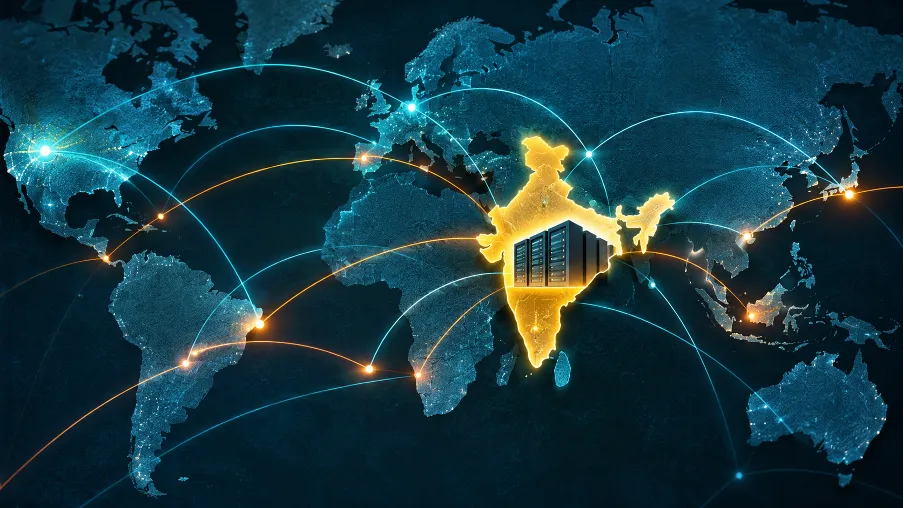
The drone strikes that damaged Amazon Web Services (AWS) facilities in the United Arab Emirates and Bahrain in March 2026 offered a demonstration of the physical vulnerabilities of the digital economy. Reuters, citing an AWS update, reported that two facilities in the UAE were directly hit and that a nearby strike in Bahrain also damaged AWS infrastructure. Power and connectivity disruptions affected cloud services. AWS warned that restoring operations would take time and advised customers to move workloads to unaffected regions. Data centres face the same risks that ports, power stations, and telecommunications networks do.
India is investing heavily in computing infrastructure. The drone strikes raise vital questions. Can India gain greater strategic control and boost national security by bringing data centres within its borders? Where do the vulnerabilities lie? The physical location of the infrastructure determines which country's jurisdiction applies, who can regulate access and who is responsible for its security.
The questions over jurisdiction are sensitive. Who has ultimate authority over defence or financial data housed in a foreign-owned data centre? Bringing data centres onshore gives India greater jurisdiction over their physical infrastructure and the data they hold. But legal authority does not automatically translate into operational control, particularly when foreign companies manage the platforms and technologies on which access depends. During war or serious geopolitical tensions, these vulnerabilities could become critical. Location, however, is only part of the equation.
The economic stakes are growing. The strategic value of onshoring lies equally in the choices it makes possible: selecting providers, distributing workloads, developing alternatives and keeping essential systems running when external relationships become uncertain. A data centre may be in India while depending on foreign processors, memory, software, cloud-management systems and technical support. Territorial presence is important but operational sovereignty remains elusive when control over the technologies, platforms and intellectual property that generate much of the value lies outside India’s borders.
A recent assessment by Rhodium Group, an independent policy and economics research firm, identifies this tension. Computing capacity is expanding faster than India’s domestic demand and utilisation. A substantial share of new infrastructure could, therefore, serve global cloud providers and overseas customers rather than Indian enterprises. India would supply land, electricity, connectivity, and an investment environment, while the platforms, models and the commercial value remained under foreign control. But hosting global computing capacity does not, by itself, guarantee domestic technological capability or security.
Hosting global computing capacity does not, by itself, guarantee domestic technological capability or security.
Indian businesses could become dependent on foreign-controlled cloud platforms, AI models and software, with limited ability to change providers or retain a greater share of the value generated. Defence sector dependence on external computing technologies, specialised components and technical support could constrain operation of systems used for intelligence, command-and-control, communications and logistics.
American companies dominate much of the international cloud business. Amazon Web Services, Microsoft Azure and Google Cloud benefit from scale, capital, proprietary software and established customer ecosystems. China has developed a concentrated domestic market around Alibaba, Huawei and Tencent, backed by a substantial manufacturing base and state-supported technology development. US-China competition extends well beyond cloud services to semiconductor design, advanced memory, manufacturing equipment, networking and artificial intelligence.
India's reliance on American providers brings access to advanced technology and global scale, but also exposure to American regulatory and export-control decisions. Chinese providers raise different concerns about security, jurisdiction, and relationships with Beijing. These are not merely commercial choices. Washington can restrict access to advanced chips and computing technology. Beijing has leverage through its manufacturing ecosystem and position in critical materials. The two powers exercise influence over different, interconnected parts of the technology chain. A US rule issued in November 2026 shows how export controls on certain advanced computing technologies can extend beyond the physical shipment of equipment to remote access through data centres in third countries.
The geopolitical contest over AI infrastructure may also reshape where companies invest. On November 20, US President Donald Trump threatened to impose a “tremendous tax” on American companies that build AI data centres overseas. He presented it as a way to strengthen America’s position against China. He gave no details on how the tax would work.
American cloud providers build abroad to serve customers locally, reduce latency and meet data-localisation requirements where they apply. If Washington makes overseas investment more expensive, it could slow investment by US cloud providers and complicate India’s ambitions to become a regional computing hub. It could also create openings for other investors and technology partners.
Four factors need particular attention. The first is concentration risk. Using multiple cloud providers does not necessarily diversify risk if they depend on the same semiconductor manufacturers, memory suppliers or networking components. A disruption at an upstream supplier can affect otherwise independent providers. Concentration is also geographical. Data centres clustered around a small number of Indian cities may share exposure to power shortages, flooding, water constraints, and telecommunications failures. This concentration creates shared vulnerabilities.
The second is technology asymmetry. Global technology companies possess capital, technical expertise, proprietary platforms, and administrative knowledge that most customers cannot replicate. India has a growing demand for computing, but limited influence over several of the technologies that support it. This imbalance affects its bargaining power. It also becomes a point of potential geopolitical weaponisation.
The third is switching cost. Once applications are built around a provider's databases, security tools and software interfaces, migration can be expensive and technically difficult. A customer may have the contractual right to change providers but might not be able to do so quickly. In a diplomatic confrontation or military crisis, lock-in is a strategic constraint. Redundancy, therefore, needs to extend across both Indian and foreign-owned providers.
The fourth is substitutability. An alternative provider is useful only if it has the capacity, software compatibility, and expertise to replace the incumbent. A second data centre is not a viable backup if it cannot run the same applications. A domestic cloud provider cannot immediately substitute for a hyperscaler if it lacks the specialised computing capacity required. In a geopolitical crisis, alternatives must be technically usable and geopolitically accessible when needed. Strategic hedging has little value unless India can change suppliers, platforms, and technology partners without interrupting key operations.
Strategic hedging has little value unless India can change suppliers, platforms, and technology partners without interrupting key operations.
The defence implications are serious. Command systems require secure, low-latency access to information across dispersed formations. Intelligence systems process data from satellites, aircraft, unmanned platforms, and ground sensors. Logistics systems support equipment availability, maintenance, forecasting of spare-parts requirements, transportation, and mobilisation. Disruption to these functions can impair operational readiness even when frontline communications remain intact.
The Indian Army's establishment of two edge data centres in October 2025 reflects the growing importance of distributed computing. According to the Ministry of Defence’s 2025–26 annual report, the facilities host applications intended to improve operational efficiency and situational awareness, including during unforeseen disruptions. Edge facilities bring processing closer to operational users and reduce reliance on central systems. But they require secure communications, redundancy, and the ability to function when networks are degraded or disconnected. Military systems cannot assume uninterrupted access to commercial cloud platforms or foreign technical support. In the financial sector, the RBI has mandated that payment-system data be stored in India and requires banks using cloud services to address data sovereignty, security and operational resilience.
India's manufacturing capabilities remain uneven and add another layer of vulnerability. Assembly and selected electronics production have advanced faster than domestic manufacturing of advanced processors, high-bandwidth memory, semiconductor equipment, and enterprise storage. Data centres require power-management systems, transformers, switchgear, and cooling equipment. These offer opportunities for domestic manufacturers, but vital supply-chain dependencies remain. Partnerships with Japan and South Korea, which have the requisite capabilities, can diversify access. But they cannot substitute for greater domestic manufacturing depth.
India’s installed data-centre power capacity rose from 375 MW in 2020 to 1.57 GW in August 2026 and is projected to reach nearly 8 GW by 2030, according to government figures. However, additional capacity does not amount to technological control. Expansion will also require reliable electricity, cooling, water and telecommunications. Without domestic geographical diversification, onshoring could simply relocate the points of failure.
India needs to build resilience at three levels. The first is component-level resilience: diversified procurement, selective domestic manufacturing, inventories of critical components and partnerships with countries that produce essential technologies. The second is ecosystem-level autonomy: domestic cloud platforms, AI models, software, data-management systems, and cybersecurity capabilities that provide alternatives to foreign-controlled platforms. The third is infrastructural sovereignty: the ability to operate, secure, maintain and recover essential systems under Indian authority.
These factors reinforce one another, without being interchangeable. India need not choose between attracting global data-centre investment and developing its own computing capabilities. It should do both. But investment must accompany the growth of domestic capabilities that give Indian businesses and public institutions effective alternatives. These would reduce concentration risk, narrow the asymmetry between global providers and domestic users, and lower the costs of switching platforms when commercial or geopolitical circumstances change.
India's strategic autonomy will depend both on where its computing infrastructure is located and on whether it has the domestic capability and capacity to operate, access and secure it, and, when necessary, to shift critical workloads and services swiftly to alternative systems. The objective is not to reduce the presence of global providers, but to ensure that their presence strengthens India's computing ecosystem without making its essential economic and security functions vulnerable.
Join the conversation
Vivek Y. Kelkar
Researcher, Analyst & Columnist on Geo-economics, Geopolitics and Sustainability
Vivek Y. Kelkar is a researcher, analyst, and columnist working at the intersection of geo-economics, geopolitics, and sustainability. His work explores global power shifts, strategy, trade transitions, and the geopolitics of climate-related systemic risk—integrating political economy with emerging trends across China, Southeast Asia, and the Middle East. He also writes for Moneycontrol, Modern Diplomat, Asia Times, and The Spectator.
Vivek brings extensive global management experience in M&A, strategy, brand and stakeholder management, and sustainability, alongside deep involvement in media.
He is a Visiting Faculty at IIM-Indore, and has delivered conference papers and participated in expert panels with institutions like the Institute of Chinese Studies, India, besides moderating at online forums.
Vivek holds an MA in International Political Economy from the University of Sheffield and an MBA from Ashridge Business School.
Beyond the noise is the signal.
FF Insights: Sharpen your edge, Monday–Friday.
FF Life: Culture, ideas and perspectives you won't find elsewhere — Saturday.

Founding Fuel is sustained by readers who value depth, context, and independent thinking.
If this essay helped you think more clearly, you may choose to support our work.

Founding Fuel is sustained by readers who value depth, context, and independent thinking.
If this essay helped you think more clearly, you may choose to support our work.
Loading comments...




Readers also liked

·Business & Strategy
Who Can Break the Tata Deadlock?
Noel Tata is trying to convert stewardship into authority. N Chandrasekaran must turn a contested board decision into shareholder support. Shapoor Mistry holds votes both men may need—and needs liquidity neither can promise alone.
IG

Indrajit Gupta
Co-founder and Director | Founding Fuel
Who Can Break the Tata Deadlock?
Noel Tata is trying to convert stewardship into authority. N Chandrasekaran must turn a contested board decision into shareholder support. Shapoor Mistry holds votes both men may need—and needs liquidity neither can promise alone.
Co-founder and Director | Founding Fuel

·Economy, Policy & Society
Who Was the School Day Built For?
India’s school system was built to educate at scale. Its classrooms, exams and incentives reveal what that design rewards—and the individual child it struggles to see.
NA

Nandita Abraham
Founding Dean | BITS Design School, Mumbai
Who Was the School Day Built For?
India’s school system was built to educate at scale. Its classrooms, exams and incentives reveal what that design rewards—and the individual child it struggles to see.
Founding Dean | BITS Design School, Mumbai

·Leadership & Organisation
Who Owns the Fire?
A leader can light the spark. The harder question is what happens to the fire afterwards?
SP

Satish Pradhan
Independent Consultant
Who Owns the Fire?
A leader can light the spark. The harder question is what happens to the fire afterwards?
Independent Consultant
Explore more
Dive into other themes from our network.