
What a Lasting Tata Settlement Must Resolve
Ahead of Tata Sons’ pending AGM, the fight over leadership and listing is widening. A lasting settlement must resolve who decides, how capital is used and whose interests count.
7 October 2026· 7 min read
TL;DR
As Tata Sons approaches its reconvened AGM, disputes over N. Chandrasekaran’s leadership, regulatory pressure to list, and relations with Tata Trusts expose deeper governance fault lines. The article argues that any durable settlement must clarify decision-making authority among shareholders, trustees, nominee directors and the board; establish transparent leadership selection and accountability; and rigorously review long-term investments such as Air India, digital ventures and semiconductors. It must also address the SP Group’s liquidity needs, regulatory expectations and protections for philanthropic beneficiaries. Whether Tata Sons lists or remains private, its patient capital requires stronger institutions, disclosure, succession planning and oversight beyond personalities.
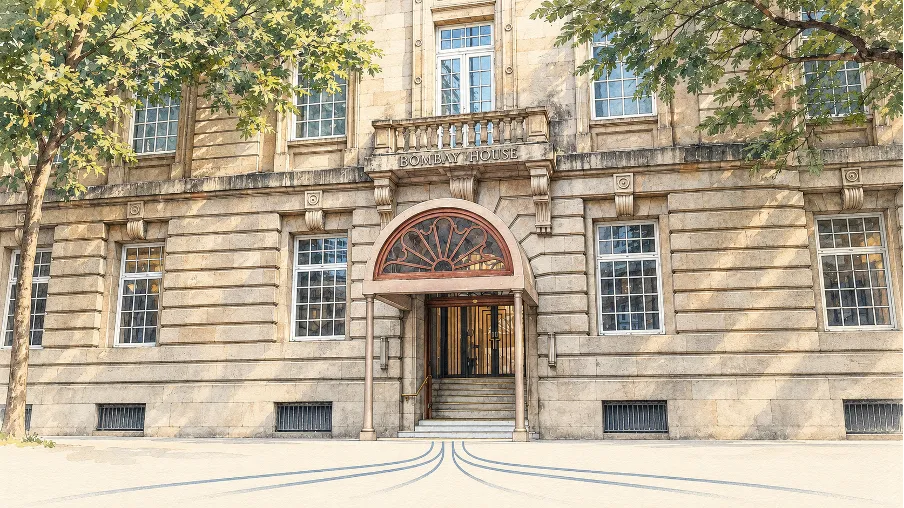
Tata Sons is reportedly preparing to reconvene its adjourned annual general meeting within weeks. Shareholders will be asked to vote on N. Chandrasekaran’s reappointment as a director. That vote matters because he needs to remain a director to continue as chairman.
On 12 August, Chandrasekaran said he would not seek another term as chairman when his current one ends in February 2027. On 17 September, days after the Reserve Bank of India rejected Tata Sons’ request to give up its registration as a core investment company, the board asked him to reconsider. It voted four to one to approve another five years. Noel Tata voted against, and the Trusts have called the decision invalid.
There may be sound reasons for the board’s change of course. The RBI’s decision made regulatory compliance more urgent, and the board may have felt that keeping Chandrasekaran would help it navigate that challenge. But it needs to explain its reasoning. What changed between August and September? Who had the right to decide? How much weight did the board give the views of its majority shareholder?
Three questions now overlap. Who decides for Tata Sons? How should it judge investments that may take years to pay off? And what would listing change for the Trusts, the board and other shareholders? Each matters whether Chandrasekaran stays or leaves. Together they will determine whether Tata can reach a settlement that lasts beyond the people involved in this dispute.
Who decides for Tata Sons?
Tata Trusts own roughly two-thirds of Tata Sons. That gives them an important say in how the group is governed. But a shareholder’s rights and a director’s duties are different. A director nominated by the Trusts must understand their purpose while also meeting his or her responsibilities to Tata Sons.
The distinction between consulting a director and instructing one therefore matters. The Trusts have shareholder rights and special rights under Tata Sons’ Articles of Association—the company’s governing rules. How should they use those rights when trustees disagree, or when the Trusts and the board take different views? Directors need room to exercise their own judgment. The board must also answer reasonable questions from its majority shareholder.
This is already a live dispute. Noel Tata and three fellow trustees of the Sir Dorabji Tata Trust say its September 16 resolution asked Venu Srinivasan not to participate in or vote on listing matters. Srinivasan maintained that the Trust could not tell him how to exercise his judgment as a Tata Sons director.
Chandrasekaran’s reappointment raises a related question. Under Article 121, decisions requiring a board majority also need the support of more than half the Trust-nominated directors present. The two nominees split: Noel Tata against, Venu Srinivasan in favour. Tata Sons says the chairman’s casting vote—the extra vote used to break a tie—resolves the split between the nominees. The Trusts say one of two is not a majority, and a casting vote cannot make it one. A legal ruling may settle what the rules allow. Tata will still need a way for trustees, directors and management to resolve future disagreements.
There is also the question of who speaks for the Trusts. Since May, the Maharashtra Charity Commissioner has stopped the Sir Ratan Tata Trust from meeting while a dispute over its board membership continues. This has complicated Tata Sons’ AGM too. Divisions within the Sir Dorabji Tata Trust have added another difficulty: Srinivasan and fellow trustee Vijay Singh have questioned whether a proposal to merge two group companies into Tata Sons was properly authorised.
In response, Noel Tata and the three fellow trustees say the proposal follows earlier unanimous decisions to keep Tata Sons unlisted. They also say the Tata Sons board asked them to explore alternatives to listing. Their argument is that they are protecting the Trusts’ main asset. The question is whether those earlier decisions authorised this particular proposal, and what consultation was required.
Would they accept the rules they defend today if those rules produced a result they disliked?
The same test should apply to every side: would they accept the rules they defend today if those rules produced a result they disliked? Would the Trusts accept a casting vote that installed a chairman they favoured? Would the board defend a nominee’s right to disagree with the Trusts if he used that freedom to oppose management? Both institutions also need a clear way to choose leaders when those making the choice are divided.
How should Tata judge its big bets?
The question of who decides leads to another: how should those decisions be judged? Noel Tata’s reported concerns about losses at Air India and Tata Digital deserve answers. The group is trying to turn around an airline while investing in chipmaking and packaging, electronics manufacturing, batteries, electric vehicles and digital commerce. A majority shareholder is entitled to ask how these investments are performing.
These businesses need different amounts of time to succeed. For each investment, Tata needs to explain what it is trying to build, how much money it has committed, what progress it expected and what has happened so far. When would it invest more, find a partner, change course or withdraw?
Patience needs regular review, or it can become an excuse to delay difficult decisions.
Patient capital—the ability to stay invested for years before seeing a return—is a strength of the Tata model. It allows bets that other owners might not sustain. But patience needs regular review, or it can become an excuse to delay difficult decisions. Shared principles and personal trust have helped Tata resolve differences. When relationships break down, concerns that went unrecorded can return as accusations. Recording the reasons for an investment, and any reservations about it, helps everyone judge it fairly later. Noel’s questions deserve answers through such a review.
Some investments now matter well beyond Tata. The electronics ministry reportedly sought, and received, an assurance that the group’s roughly $14 billion semiconductor and electronics programme would continue despite the dispute. Tata is developing India’s first commercial chip fabrication plant at Dholera, alongside its chip packaging facility in Assam. The Centre offers substantial support, including 50% of the project cost for approved semiconductor fabrication plants. Public money, India’s ability to make chips and the confidence of technology partners are all at stake.
The government therefore has a legitimate interest in keeping these projects on track. Uncertainty at Tata can also affect opportunities for other Indian groups, global competitors and technology partners. But the projects’ national importance cannot decide who should chair Tata Sons. If they depend too heavily on one person staying in office, Tata needs stronger teams, clearer processes and a better plan for succession. Otherwise a boardroom dispute can put national priorities at risk.
What would listing actually change?
The RBI has placed Tata Sons in the upper layer of non-banking finance companies, a category subject to rules that require listing. Its rejection of the request to give up registration has made the issue urgent. The four trustees argue that the RBI’s letter did not say listing was the only way to comply. Whether the proposed restructuring provides an acceptable alternative is for the regulator to decide.
An IPO would change who can invest in Tata Sons, how easily shareholders can sell their stakes and who can question its decisions. The Shapoorji Pallonji (SP) Group is the clearest example. Its 18.37% holding is valuable but hard to turn into cash. The SP Group has supported listing, which would make its shares easier to sell and establish a market price for them, including those pledged against its borrowings.
Yet at the September board meeting, Noel Tata presented a plan for at least ₹25,000 crore to buy part of The SP Group’s stake while keeping Tata Sons private. The SP Group needs a credible way to raise money from its holding. That alone does not mean Tata Sons must list. Any private deal would have to work for both the SP Group and Tata.
Listing would bring new shareholders with rights to information and a say in how Tata Sons is governed. Investors would gain access to the holding company. An IPO of this scale would also mean substantial work and fees for investment banks, lawyers and advisers.
Global finance is watching the dispute. During his recent India visit, JPMorganChase CEO Jamie Dimon praised Chandrasekaran and supported greater public transparency. He did not, however, call for a Tata Sons IPO.
The people who benefit from the Trusts’ charitable work have far less say in this contest. Yet they depend on the long-term health of Tata Sons and the income it provides for philanthropy. Keeping control, getting the best financial return and protecting a lasting source of income may lead to different choices. Trustees must explain how they balance those goals.
Listing need not end patient capital. Listed Tata companies have pursued long-term plans while answering to public shareholders. Tata Sons would need to explain its purpose and how it balances the interests of all its owners. Public investors may ask many of Noel’s questions about where money is being invested, the returns it earns and dealings with connected parties. They may also ask about the Trusts’ role. A private Tata Sons would still need effective scrutiny and a clear account of its decisions.
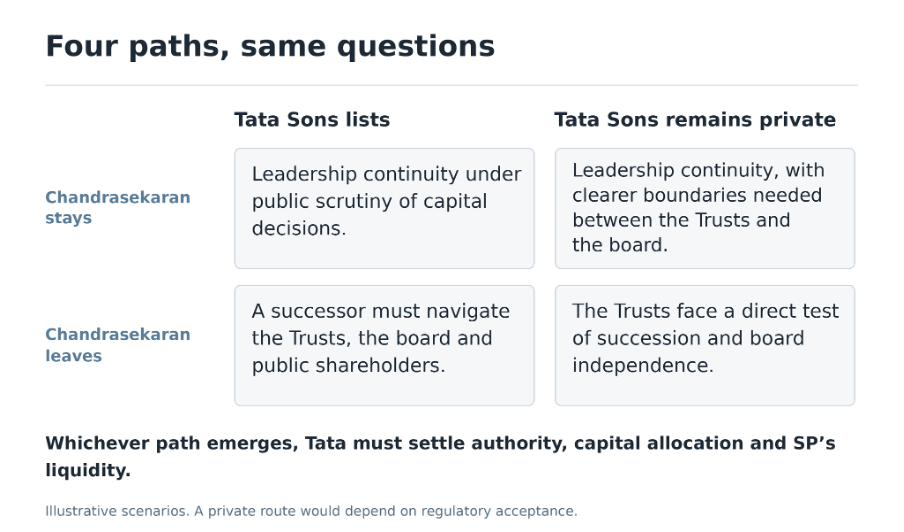
The merger proposal will test whether Tata can find an alternative to listing that the regulator and other shareholders accept. It would bring Tata Electronics Systems Solutions and Tata Consulting Engineers into Tata Sons to change its regulatory status. Whichever route is taken, Tata must agree who can approve large investments, how those decisions will be reviewed and what rights the Trusts and the SP Group will have.
There are four possible outcomes, depending on whether Chandrasekaran stays or leaves and Tata Sons lists or remains private. The grid sets them out.
What would a lasting settlement require?
Tata’s rules, conventions and relationships have long balanced business, philanthropy, ownership and management. Exceptional leaders could resolve competing demands personally. But their authority is harder to pass on than a title or a shareholding. The present dispute shows the cost of leaving too much understood but unwritten.
A lasting settlement must make clear which decisions need the Trusts’ approval and where nominee directors can exercise their own judgment. It must set out how the chairman will be chosen and evaluated, and how investments with different timelines will be reviewed. It must address the SP Group’s need to sell part of its stake. And it must establish clear rules for disclosure, conflicts of interest and dealings with connected parties, whether Tata Sons lists or stays private.
These tasks cannot wait. The dispute now involves the Tata Sons board, leadership succession, banking and charity regulators, the SP Group’s finances and national industrial policy. People outside the boardroom are affected too: the Sir Ratan Tata Trust has said proposed grants of around ₹400 crore await decisions while it cannot meet. The longer Tata takes to reach its own settlement, the more regulators, courts and other stakeholders may shape the outcome.
Tata’s unusual structure brings long-term investment, professional management and a wider social purpose together. A settlement should preserve that strength while making clear who decides, who can question those decisions and who must answer for them.
The test is whether Tata will be better governed after the people in this dispute have gone. The chairmanship and listing matter. A lasting settlement must also explain why those who control Tata’s patient capital should be trusted with that power, and how they will be held to account.
Dig Deeper
The Real Question Behind a Tata Sons Listing
September 15, 2026
Does Tata’s patient capital and stewardship require privacy—or can they endure alongside greater public accountability?
The Battle for the Tata Inheritance
September 28, 2026
How Tata’s intertwined roles in philanthropy, ownership and corporate governance are being tested after Ratan Tata.
Join the conversation
Satish Pradhan
Independent Consultant
Satish Pradhan is an independent consultant.
He was on the Governing Council of Tata institute of Social Sciences and the board of Bombay Natural History Society and the Advisory Board of the School of Vocational studies at TISS. He was an Adjunct Faculty at TISS Tuljapur.
He Co-Chaired a Global HR Innovation Network with Walt Cleaver, and has been the Convener of the Social Innovation Conference of Pune International Centre.
He was Advisor to the Tata group from May 2013 till January 2015. He retired as Chief Group Human Resources, Tata Sons in May 2013. At Tata Sons he headed the Tata group HR function. In the preceding twelve years, he built on the legacy of the two (50-year-old) institutions of TAS (Tata Administrative Services) and TMTC (Tata Management Training Centre) and created a unique HR function in the group. Prior to joining the group in April 2001, he was with ICI Plc in London at their Head Office as Organisation Design & Development Manager (Group Human Resources).
He has a Masters in History from Delhi University and is a Chartered Fellow of the Chartered Institute of Personnel Development (UK) (equivalent to a PhD).
He has worked in Public Sector and Private Sector companies. During the last 40 years he has worked with Steel Authority of India Ltd, CMC Ltd, ICI India Ltd, Brooke Bond Lipton India Ltd (now Unilever India), ICI Plc. in various leadership roles.
He was on the Boards of the National Payments Corporation of India and Tal Manufacturing Solutions Limited till 2020, and on the Boards of Tata Autocomp Systems Ltd, , TGY Batteries , Tata Services Limited, Computational Research Laboratories and on the Strategic Advisory Board of IIT Roorkee, amongst others.
He has been a speaker and advisor in addition to being the recipient of many awards and honorary Doctorate.
Leadership , Board advisory, CEO coaching, organisation strategy and design are his areas of interest. Conservation and community are the other two spaces he has passionately worked in. He is a founder of The Leadership Centre and the Shrusti Conservation Foundation.
Beyond the noise is the signal.
FF Insights: Sharpen your edge, Monday–Friday.
FF Life: Culture, ideas and perspectives you won't find elsewhere — Saturday.

Founding Fuel is sustained by readers who value depth, context, and independent thinking.
If this essay helped you think more clearly, you may choose to support our work.

Founding Fuel is sustained by readers who value depth, context, and independent thinking.
If this essay helped you think more clearly, you may choose to support our work.
Loading comments...



Readers also liked

·Economy, Policy & Society
A World Without Endgames
What prolonged global conflicts mean for Europe, China—and India’s narrowing strategic space.
VK

Vivek Y. Kelkar
Researcher, Analyst & Columnist on Geo-economics, Geopolitics and Sustainability
A World Without Endgames
What prolonged global conflicts mean for Europe, China—and India’s narrowing strategic space.
Researcher, Analyst & Columnist on Geo-economics, Geopolitics and Sustainability

·Leadership & Organisation
My 10 best business books of summer 2025
On what makes a leader, how to stop wasting energy on the wrong things, speaking well, the history of attention, understanding India’s economic planning, and more
DS

D Shivakumar
Operating Partner | Advent International
My 10 best business books of summer 2025
On what makes a leader, how to stop wasting energy on the wrong things, speaking well, the history of attention, understanding India’s economic planning, and more
Operating Partner | Advent International

·Technology & the Future
What they don’t tell you about EVs in India
A guide to owning electric cars and scooters—from ease of use, to running costs, charging networks, reliability, and more
PS

Pranav Srivilasan
Independent consultant and writer
What they don’t tell you about EVs in India
A guide to owning electric cars and scooters—from ease of use, to running costs, charging networks, reliability, and more
Independent consultant and writer
Explore more
Dive into other themes from our network.