

·FF Life
The Happiness We Keep Postponing
A reflection on joy, and why the ordinary day may be enough
HC

Haresh Chawla
Investor | Entrepreneur
A Danish startup wants to take a faster road to thorium and manufacture nuclear reactors by the thousands. Its audacious bet raises a question for India: what happens if the nuclear world changes before Homi Bhabha’s long-term vision is complete?
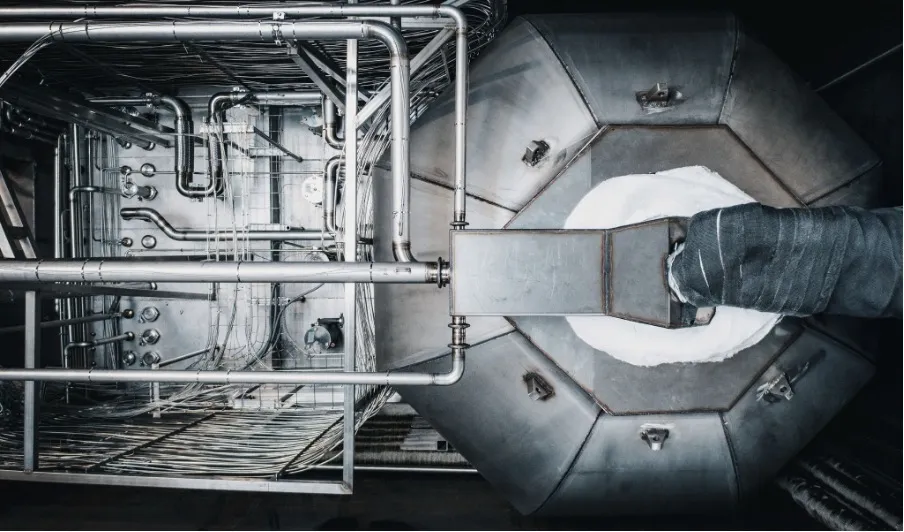
Artificial intelligence has unexpectedly made a taken-for-granted everyday utility—electricity—interesting again.
Only a few years ago, most discussions about energy revolved around climate change. Today, governments worry about powering artificial intelligence, data centres and advanced manufacturing. Companies see energy as a potential bottleneck to technological progress, while strategic competition between nations has brought industrial policy back into fashion. Reliable electricity has once again become a question of economic power, national security and geopolitical vulnerability.
Not surprisingly, nuclear power has returned to the centre of that debate. It is the only clean source of 24/7, all-weather, high-density dispatchable power. A global nuclear revival is underway.
Yet much of the discussion remains trapped in familiar questions. Can nuclear power be made cheaper and built faster? Can new reactor designs overcome the problems that have plagued the industry for decades?
For more than seventy years, civilian nuclear power has largely been organised around bespoke megaprojects, built under demanding licensing and regulatory regimes. The result has been an industry marked by delays, escalating costs and extraordinary complexity.
Thomas Jam Pedersen thinks we may be asking the wrong question.
From an industrial estate outside Copenhagen—in Denmark, a country officially opposed to nuclear power—the founder and chief executive of Copenhagen Atomics has become the evangelist of a very different philosophy:
Build and ship reactors. Build and ship reactors by truck. Build and ship reactors by truck every day.
Pedersen argues that nuclear power’s biggest challenge is no longer primarily one of reactor physics. It is a problem of industrial organisation. After years studying nuclear research going back to the 1950s, he concluded that the ideal reactor has already been invented. And the ideal fuel is already known.
The radical idea driving Copenhagen Atomics is to transform nuclear power from a succession of bespoke engineering projects into a manufacturing industry.
I have been researching India’s nuclear programme for a book, and I am particularly fascinated by Homi Jehangir Bhabha’s audacious plan to build a self-sustaining thorium economy.
For decades, it seemed that only India was still pursuing thorium as the ultimate destination of nuclear fission energy. Elsewhere, including in the United States, where foundational work on molten salt reactors had been carried out in the 1950s, thorium had largely receded from view. Many wondered whether India had saddled itself with an unrealizable vision.
Over the past few years, however, I began to realise that a new global race to thorium was quietly taking shape within the larger nuclear renewal. And the more I studied it, the more it seemed that the race was unfolding along two distinct roads.
India has been travelling one.
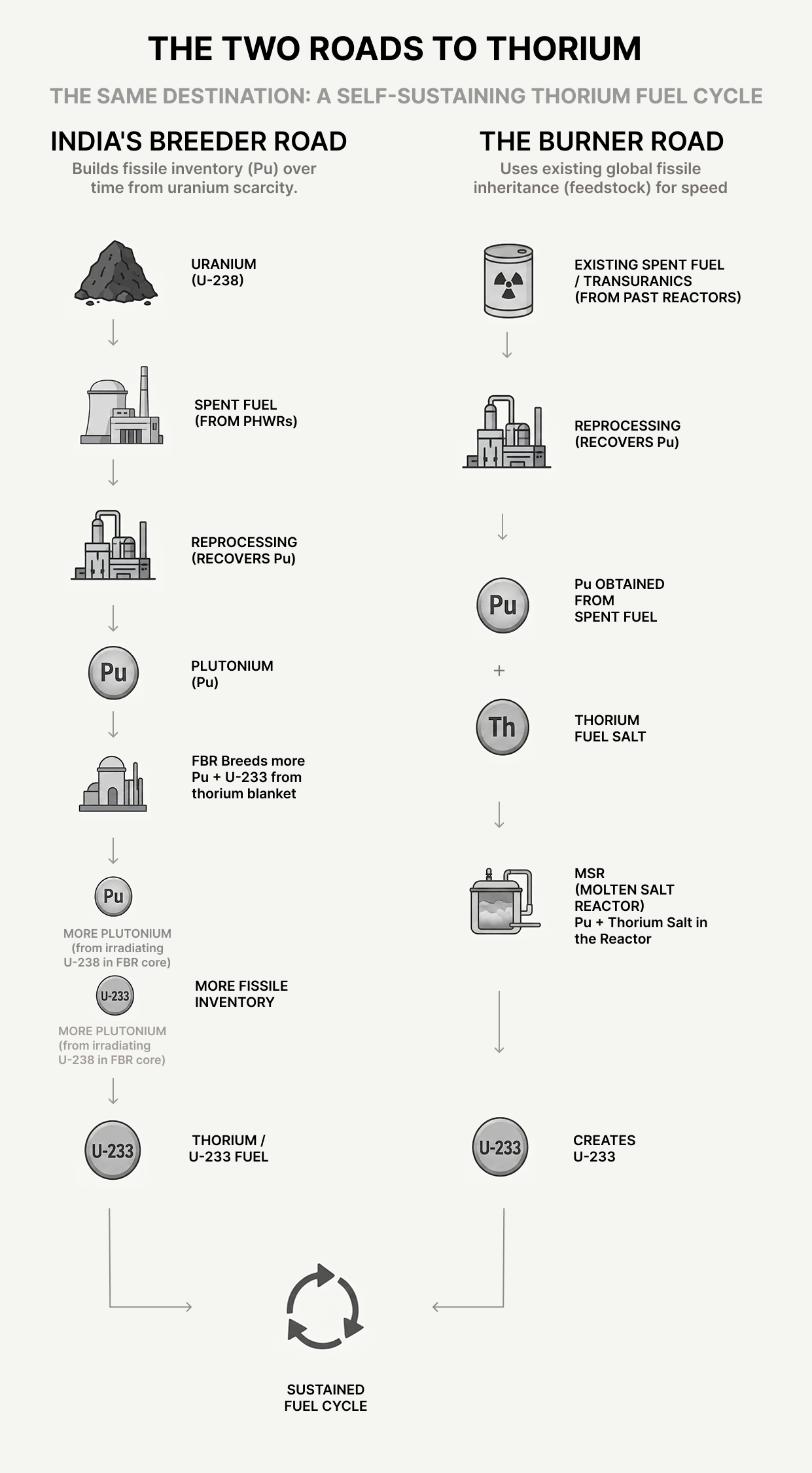
It begins with uranium. Spent fuel is reprocessed to recover plutonium, which then fuels fast breeder reactors that produce more fissile material. Eventually, that accumulated inventory can help convert thorium into uranium-233.
The journey is sequential and measured in decades. India began with little uranium and no inherited stock of spent fuel. It first had to build the fissile inventory needed to kick-start a thorium cycle.
Think of it as the breeder road to thorium.
Copenhagen Atomics represents a fundamentally different possibility.
It starts from the fact that, over the seventy-plus years of the first nuclear age, the world has accumulated large quantities of fissile material in spent nuclear fuel. Rather than spend decades building that inventory, the faster option—call it the “burner road”—is to use existing fissile material to start reactors that breed uranium-233 from thorium.
The two roads lead towards the same destination. But they begin with very different assumptions about the material that has shaped the nuclear politics of the first nuclear age.
For India, plutonium is fissile capital—an inventory to be extracted, accumulated and multiplied until it can unlock the country’s vast thorium resources.
For the burner road, existing fissile inventory can become feedstock—something that can help start a thorium fuel cycle rather than having to be created first.
That difference shapes the technologies, economics, timelines and industrial models possible on the two roads.
I had been asking myself: Are these competing paths? Could they become complementary? Could they eventually converge? Or might the success of one change the technological and geopolitical environment in which the other must operate?
That was what I wanted to explore with Pedersen—not only his unusual vision for nuclear power, but how he viewed India’s decades-long, almost lonely, persistence on the breeder road.
Pedersen and his team had recently visited India, meeting government representatives and some of the country’s largest industrial groups as India began opening nuclear power plant operations to private participation.
When a chance meeting with a representative of the Danish Consulate in Bengaluru raised the possibility of interviewing him, I jumped at it.
I had been told I would get thirty minutes.
We spoke for ninety-seven.
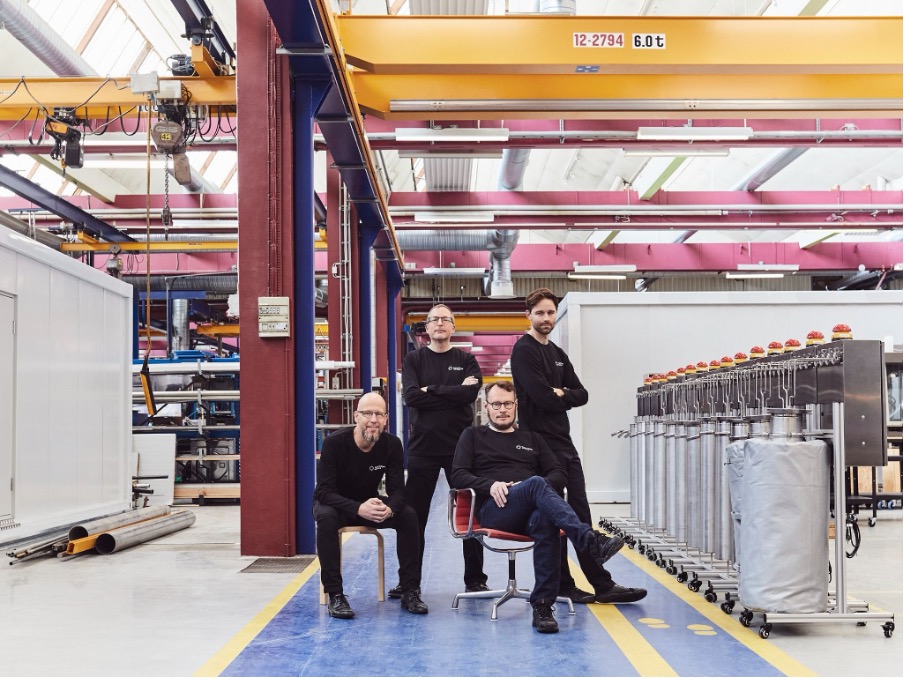
Most technology founders begin by explaining their product. Pedersen began somewhere else: with a Václav Smil-style history of energy and civilisation.
For most of human history, he said, people had access to very little energy—human and animal labour, some water power. Then came coal, oil and gas, and everything changed.
“In the last hundred years, we increased global energy consumption by about 10X,” he said.
Pedersen believes we are approaching another such leap. “The question everybody should ask is, what happens in the next hundred years? At Copenhagen Atomics, the founders of this company believe it’ll increase another 10 times.”
I expected him to turn next to climate change and nuclear power as a way to sustain such an expansion without carbon emissions. Instead, he talked about energy as the foundation for almost everything else.
“We see energy as the most important component of creating prosperity and developing other technologies. If you don’t have energy, there’s not going to be prosperity and there’s not going to be new technologies. Period. Energy is, sort of, the very first thing.”
If I can help create 10 times more energy in the world, I know a lot of interesting things will happen.
It struck me that Pedersen had an abundance mindset.
DeepMind co-founder Demis Hassabis flashed through my mind: solve intelligence first, then use intelligence to solve everything else. Pedersen seemed to be saying: solve energy first, then use energy to solve everything else.
“It really hurts me to see how stupid we humans are about energy,” he said. “We fight wars over oil. And when I say this, you'll understand a lot about me. I think 90% of people…the model they have in their head of the world is…they believe that if they have to get something, they have to take it from somebody else. They play a zero-sum game.”
Then, he said, there were people with a different mindset. “They think, ‘How can I create more than there was before? How can I enrich the world with beautiful poems, technology, or by building new stuff?’”
“There’s not very many of us building new stuff. But those people change the world. Suddenly we have airplanes, cars, computers or nuclear power plants, and they came out of nowhere. If we have energy available, it's much easier for that 10% of the population to create new things. If I can help create 10 times more energy in the world, I know a lot of interesting things will happen.”
There was an unexpected echo here of Bhabha. Seven decades earlier, and under entirely different historical circumstances, he too had begun with abundance. His vision of “electricity too cheap to meter” was not simply a prediction about nuclear power. It was a statement about what abundant energy could make possible for society.
At that point, the two roads began at the same place. They diverged on how to get there.
Pedersen’s own journey into nuclear energy was unconventional. He did not come through a national laboratory or spend his career designing reactors. He trained as an electrical engineer and went into the technology industry, working at Nokia when it was one of Europe’s leading technology companies, followed by stints in Silicon Valley and at Google.
The turn towards energy came almost by accident. While consulting for Denmark’s largest utility, Pedersen found himself modelling the Nordic electricity grid.
“I started looking at why we were doing all these stupid things,” he recalled. “There were a lot of things we were doing in the grid that were counterproductive.”
That curiosity led him to examine different sources of energy. He looked first at fusion but concluded that it could not provide energy at the scale he wanted in the foreseeable future. Eventually, he came across thorium.
“I stumbled upon thorium and realised it can scale like crazy,” he said. “Thorium could provide 100 times the energy we’re using today.”
Pedersen had not set out looking for thorium. He had been looking for an energy source capable of sustaining the expansion he believed was coming. Thorium became his answer.
Over the next three or four years, he met the people who would become his co-founders at Copenhagen Atomics. Their expertise was complementary: Pedersen brought systems and technology experience; one co-founder understood salts and chemistry; another brought reactor physics.
“If I hadn’t met them, I would never have started the company,” he said.
He then added something that seemed oddly emphatic at the time: “It was just coincidence that we met here in Copenhagen. It could have happened anywhere else in the world.”
Only much later in our conversation would I understand why that mattered.
Pedersen’s search for a thorium reactor eventually took him back to a concept that had largely disappeared from the nuclear mainstream: the Molten Salt Reactor.
Much of the foundational work had been carried out at Oak Ridge National Laboratory in the United States in the 1950s and 1960s. But the nuclear industry instead coalesced around solid uranium fuel and water-cooled reactors, while molten salt reactors receded from view.
Decades later, as the old Oak Ridge research became readily accessible online, Pedersen began working through it. What he found changed his conception of the problem. The reactor, he concluded, had already been invented and the fuel identified.
The challenge was to make an old idea work in a new industrial era.
Most commercial nuclear reactors use solid fuel—typically uranium fabricated into pellets and assembled into fuel rods. Water carries heat away from the reactor core under high pressure.
A molten salt reactor works differently. The nuclear fuel is dissolved in a liquid salt that also carries heat from the reactor. For Pedersen, that distinction is fundamental. A liquid-fuel reactor can, in principle, be refuelled while operating. Some fission products that interfere with the chain reaction can also be removed from the circulating fuel. And because molten salts operate at high temperatures without requiring the high pressures of conventional water-cooled reactors, the surrounding engineering can be very different.
Pedersen’s interest was not simply in whether this made a better reactor. He wanted to know whether it could make a reactor that was easier to manufacture.
Copenhagen Atomics’ answer is a reactor called the Onion. The name sounds whimsical, but it describes the reactor’s layered architecture. At its heart is molten fuel salt. Around it sits heavy water, which acts as a moderator, slowing neutrons to sustain the chain reaction. Encircling that is a blanket of thorium salt, which captures neutrons and breeds uranium-233.
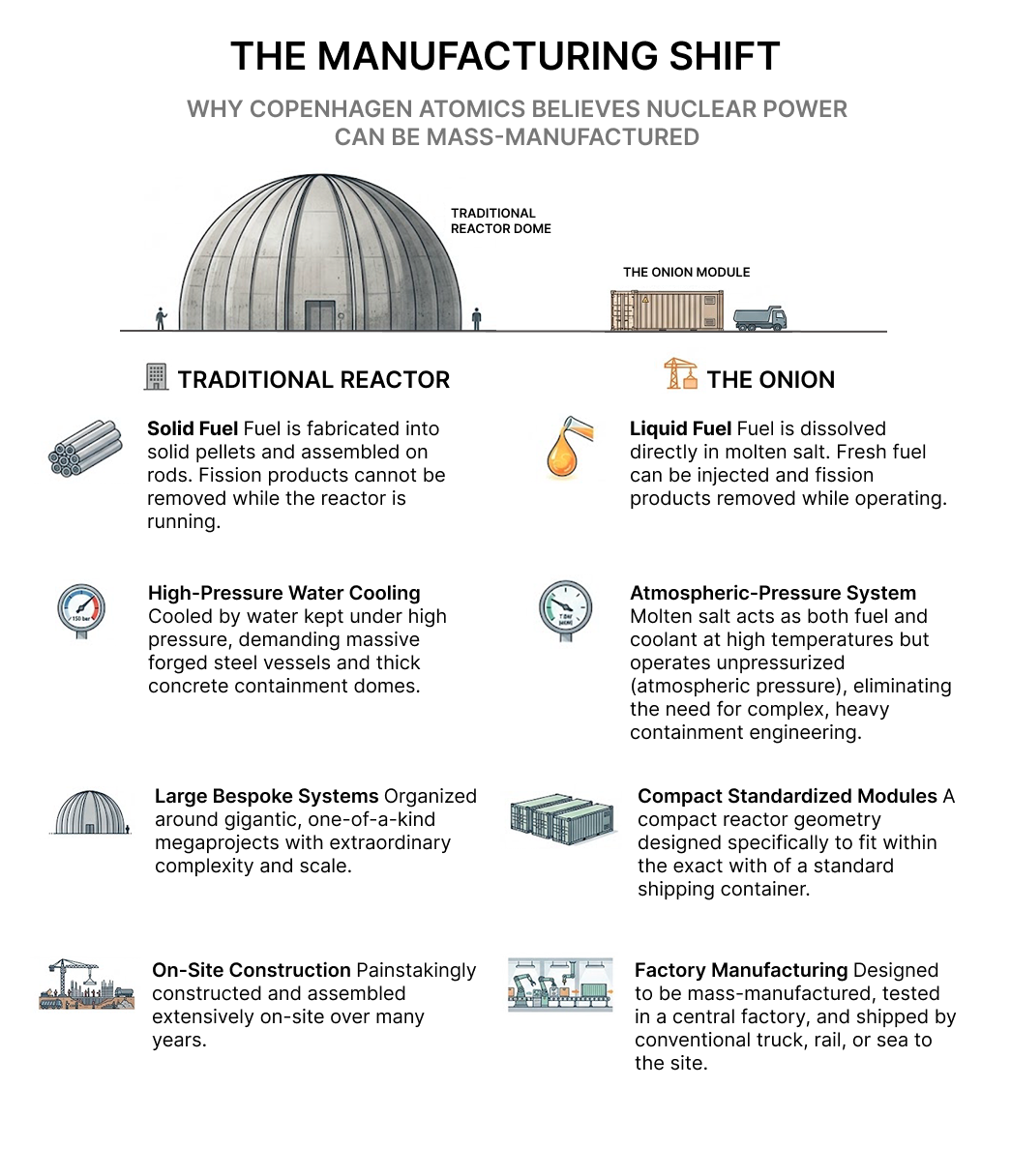
What matters for our story, however, is the size. The entire reactor core, designed to produce about 100 MW of thermal power and roughly 42 MW of electricity, is about 2.5 metres in diameter—roughly the width of a standard shipping container.
“We were lucky,” Pedersen said.
Copenhagen Atomics had not designed the reactor around the global logistics system. Pedersen says computational modelling produced a geometry that happened to fit conventional transport dimensions.
That coincidence opened up a different industrial possibility: build and test the reactor in a factory, then transport it by road, rail or sea to a power station.
As Pedersen described it, another iconic Danish invention came to mind.
LEGO.
The analogy isn’t that the Onion is simple. It is that standardised units can become building blocks, with multiple reactor modules feeding heat into a common power-conversion system.
But had Copenhagen Atomics merely hidden enormous engineering complexity beneath an elegant exterior? Or did the Onion represent a genuinely different philosophy of nuclear engineering?
I put that question to Pedersen. He pointed to advances in computational modelling.
For Pedersen and his co-founder and CTO Aslak Stubsgaard, the Onion would have been extraordinarily difficult to design twenty years ago. Modern simulation tools allowed them to model how the fuel salt, thorium blanket, moderator and structural materials interacted—and to explore configurations that earlier generations could not model with the same precision.
The simplicity of the Onion, then, did not come from eliminating complexity. It came from trying to put more of that complexity into the design before the reactor reached the factory floor.
Copenhagen Atomics was not trying to build a one-off engineering achievement. It wanted a product that could be manufactured repeatedly.
Eleven years ago, I stood inside India’s Prototype Fast Breeder Reactor at Kalpakkam as engineers painstakingly assembled a machine of extraordinary scale and complexity.
“Everything about the PFBR is enormous. Everything about it is first-of-a-kind,” Prabhat Kumar, the first Director of BHAVINI, the company created to build the reactor, told me then.
It felt like a cathedral of engineering.
The reactor brought together enormous vessels, intricate piping, hundreds of tonnes of highly reactive sodium, multiple types of sensors and multiple layers of safety systems. Components too large to travel by road had to be fabricated at site. Indian companies had to develop manufacturing capabilities for equipment that had never before been made in the country.
None of that complexity was accidental or gratuitous. It arose from the reactor India had chosen to build and the strategic purpose it was designed to serve.
But standing virtually in front of Pedersen’s Onion years later, the contrast was hard to miss.
One reactor embodied the industrial logic of a national megaproject. The other was being designed around the possibility of becoming a manufactured module.
One reactor embodied the industrial logic of a national megaproject.
The other was being designed around the possibility of becoming a manufactured module.
Mass manufacturing was not something Copenhagen Atomics discovered after designing the Onion. It was the premise on which the company was founded.
“When we realised thorium can provide huge amounts of low-cost energy, all four founders agreed that we would start this company only if we could mass-manufacture reactors,” Pedersen told me. “If we could make only 10 or 20 reactors, we wouldn't care about that. We wanted to make thousands.”
Henry Ford and the Model T came to mind, and I said so.
Pedersen smiled. “Yes. He’s an icon of that manufacturing revolution. We do look at that.”
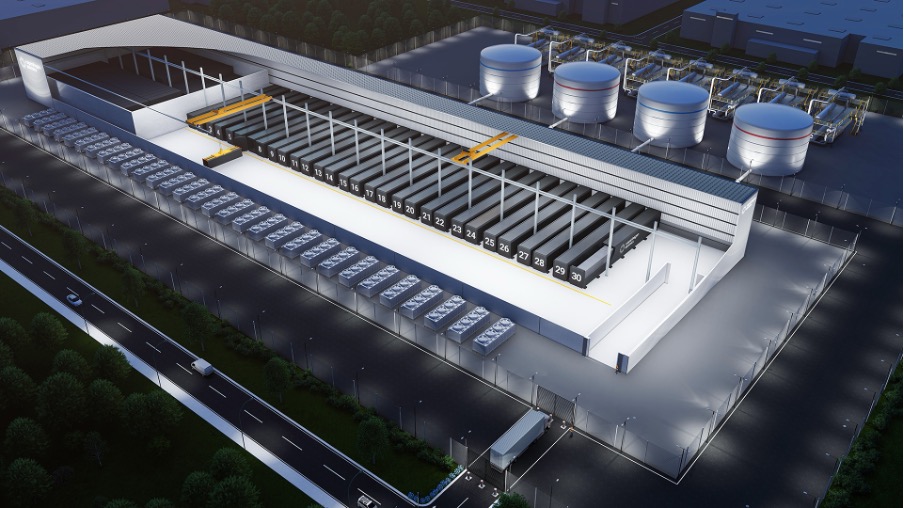
But mass production requires a repeatable product and a supply system capable of producing it again and again. Copenhagen Atomics discovered how much of that system did not yet exist.
When the founders found no commercial supply of the molten-salt fuel they needed, they built their own production capability.
When they could not find pumps capable of operating reliably in high-temperature molten salt, they developed those too. The pumps are now sold to researchers and national laboratories.
Listening to Pedersen, I caught myself thinking: Bhabha would have recognised the instinct.
Here was a startup discovering that if the ecosystem required to build its technology did not exist, it might have to create parts of that ecosystem itself.
There was even an unexpected connection between the two worlds. Like India’s uranium-fuelled Pressurised Heavy Water Reactors (PHWRs), the Onion uses heavy water as a moderator. Copenhagen Atomics sources it from India, the world’s largest producer.
Corrosion has long been one of the concerns surrounding molten-salt reactors. Pedersen is careful not to claim that Copenhagen Atomics solved it. Knowledge about controlling corrosion in molten salts, he says, already existed in non-nuclear industries.
The key, he argues, is controlling moisture and impurities in the salt.
“Corrosion becomes very low. Not zero—but low enough to run a reactor for five, maybe even ten years, without corrosion becoming a serious issue.”
But another problem cannot simply be cleaned out of the salt.
Radiation.
Intense neutron bombardment gradually damages materials around a reactor core. Eventually, components have to be replaced.
Copenhagen Atomics asks: What if the reactor module did not have to last for decades?
Its proposed answer is a module designed for an operating lifespan of roughly five years, compared with the 40–60-year lifespans for which large conventional reactors are typically engineered. At the end of that period, the reactor would be removed and replaced with a newly manufactured unit, while the irradiated module is returned for processing.
What sounds at first like a weakness becomes part of the manufacturing model.
The objective is not to maximise the life of every individual reactor. It is to optimise the economics and manufacturability of the fleet.
Copenhagen Atomics also does not intend to manufacture the entire power station. It would supply standardised reactor modules, while local partners provide much of the surrounding plant—buildings, turbines, generators, grid connections and other infrastructure.
The more Pedersen explained the model, the less the Onion looked like a standalone reactor. It looked like the basic unit of a manufacturing system.
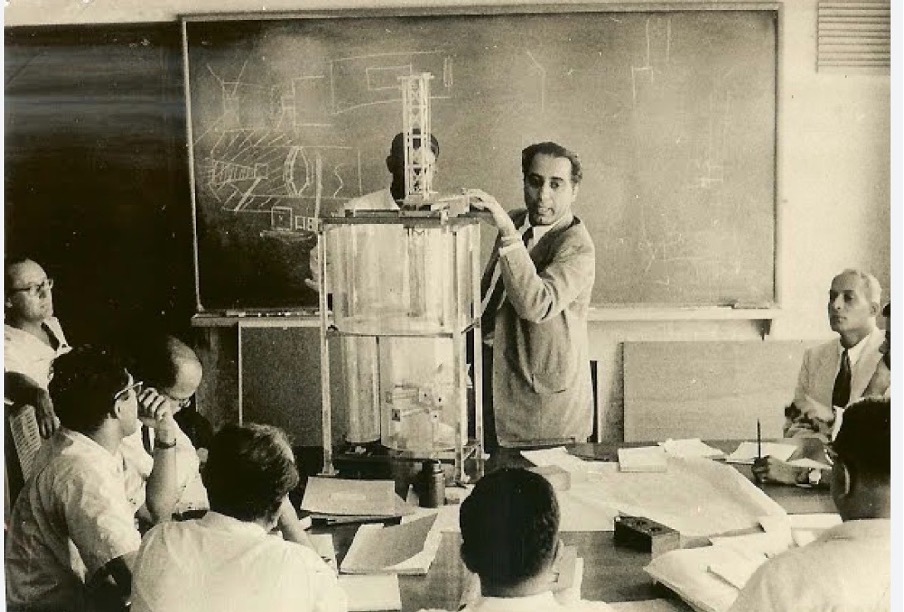
And that led me back to Bhabha.
Bhabha had faced a very different starting point.
He could not build his thorium vision around a reactor ready to be manufactured. He had to build it around a fuel cycle.
That meant building far more than reactors: uranium mining, fuel fabrication, heavy-water production, reprocessing, fast breeders, research institutions, engineering capabilities and a domestic manufacturing base capable of supporting all of them.
The complexity of India’s nuclear system was therefore not simply the result of cumbersome engineering.
It was the consequence of trying to create an entire technological and industrial ecosystem in a country that barely possessed one.
Even the heavy water that Copenhagen Atomics can now buy from India exists because that ecosystem was built.
It occurred to me that perhaps the complex nuclear world of Bhabha’s era had to be built first for someone like Pedersen to come along decades later and try to simplify it.
By this point in the conversation, it was easy to be drawn in by the elegance of Pedersen’s proposition: a compact molten-salt reactor, standardised modules manufactured in factories and transported by truck, and a reactor designed around replacement rather than longevity.
There was, however, a large gap between the proposition and the proof.
Copenhagen Atomics has been developing the Onion for more than a decade. It has built full-scale reactor containers and tested them without nuclear fuel, and a third prototype was under assembly when we spoke. But the company has not yet operated an Onion reactor under fission conditions.
“We do not have a license yet to turn on the reactor and create fission,” Pedersen acknowledged.
For now, Copenhagen Atomics can electrically heat its salts, circulate them through the system and conduct mechanical tests. The company is seeking approval to conduct its first fission experiment at the Paul Scherrer Institute in Switzerland, which Pedersen expects to happen in 2028.
Commercial deployment would come later. “The fastest we could get to a commercial reactor would be something like 2031,” he told me, while acknowledging that nuclear licensing has traditionally taken much longer.
Even that would leave Copenhagen Atomics a long way from manufacturing thousands of reactors. It still has to demonstrate that its materials, pumps, fuel salts and replacement model work together under actual nuclear conditions. Some of the very choices that make the Onion attractive as a manufactured product may also make it difficult to fit within regulatory systems designed around conventional nuclear plants.
The fuel cycle presents another challenge. Copenhagen Atomics’ longer-term thorium proposition envisages using fissile material derived from spent nuclear fuel to help start and sustain the transition towards a thorium/U-233 cycle. But spent nuclear fuel and separated plutonium are among the most tightly controlled materials in the world. International nuclear rules were built precisely to prevent fissile material from moving freely across borders.
For the burner road, then, access to fissile material is not a peripheral problem. It goes to the heart of the model.
Copenhagen Atomics also wants to retain an important role in producing, managing and recycling fuel for its reactors. It is therefore proposing elements of a different nuclear industrial system—one involving fuel production, radioactive-material handling, reactor replacement, recycling and eventually decommissioning. Each sits inside regulatory regimes built over decades around different assumptions.
The proposed five-year reactor life illustrates the challenge particularly well. Replacing an irradiated module every few years may make engineering and manufacturing sense, but somebody still has to remove it, handle it safely, process it and install another one. Pedersen says highly radioactive reactor modules would eventually have to be handled and decommissioned using robotics rather than people. That, too, remains to be demonstrated.
Pedersen is blunt about where he thinks the biggest obstacle lies.
“The difficult part is not the technology,” he said. “The difficult part is getting the approvals. It’s a funny situation.”
But approvals in nuclear power are not simply bureaucratic obstacles sitting outside the technology. They are part of the system within which the technology has to work.
Copenhagen Atomics therefore has a great deal to prove—not only that the Onion can operate under fission, but that its fuel cycle and five-year replacement model can work, that reactors can be manufactured repeatedly, and that regulators, financiers and customers can have confidence in the system as a whole.
That does not invalidate Pedersen’s proposition. It marks the distance between an elegant engineering idea and a functioning nuclear industry.
And it led me to the question that mattered most for this story: if Copenhagen Atomics—or another company pursuing a similar burner road—eventually succeeds, what would that mean for India?
Pedersen had an obvious commercial interest in India.
“India, China and the United States are by far the biggest future markets for nuclear energy,” he said.
He and several colleagues had recently travelled to India to understand what the opening of the country’s nuclear sector to greater private participation might mean for Copenhagen Atomics. They met government officials as well as executives from NTPC, L&T, Tata, Reliance, Adani and several smaller companies.
“We’ve had a lot of interest from Indian companies asking whether we could collaborate and help build something here,” he said. “We would love to do that, but we don’t quite know exactly what’s possible.”
The impression Pedersen had formed of India’s nuclear journey was less flattering. “It seems to me that the traditional nuclear industry had been somewhat slow and very bureaucratic,” he observed. “So, the government called up these large conglomerates and said, ‘Hey, we need to expand nuclear power urgently. Can you help build it?’”
Yet he was bullish about what might happen next. “Can India build 100 gigawatts of nuclear power by 2047?” he asked, before answering his own question. “I’m 100% sure it can. Maybe even more.”
For Pedersen, the obvious measure of success was electricity generation. From that perspective, India’s progress inevitably appeared slow. But Bhabha’s three-stage programme was designed around a different constraint.
India needed to move from limited domestic uranium resources towards its much larger reserves of thorium. In the first two stages, therefore, electricity generation was not the only—or even the principal—strategic objective. India needed to accumulate fissile inventory, particularly plutonium, that could eventually help unlock a much larger thorium-based nuclear system.
Decades of sanctions and technology-denial regimes added another imperative: sovereign control over the fuel cycle.
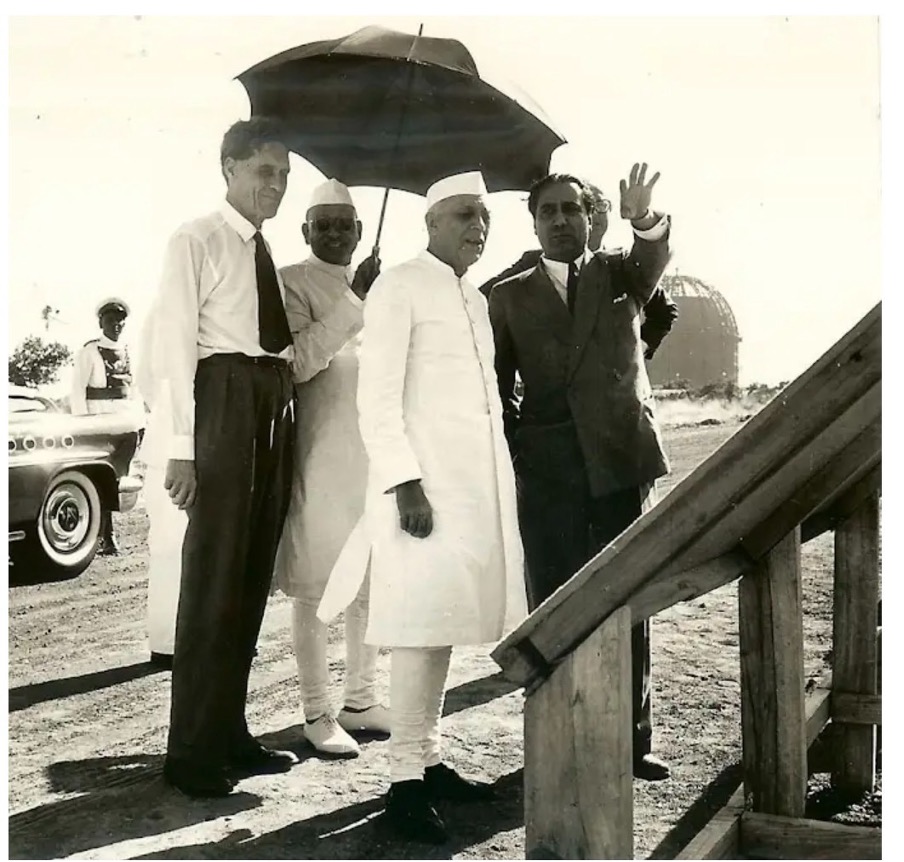
Pedersen understood the argument. “I get that, and I think India should continue,” he said. He expected India to continue building PHWRs and sodium-cooled fast breeder reactors, but questioned whether that remained the fastest route forward.
“The fastest route is to allow a little more foreign technology onto your soil and then learn from it.”
Speed and sovereignty are not always optimised by the same choices.
That brought us back to a tension that runs through India’s nuclear programme: speed and sovereignty are not always optimised by the same choices.
For Copenhagen Atomics, fissile material that already exists elsewhere could eventually become feedstock for a thorium fuel cycle. For India, fissile material is the strategic capital it has spent decades building precisely because it did not want its nuclear future to depend on somebody else supplying it.
Pedersen remained unconvinced that sodium-cooled fast breeders would ultimately match the economics of molten-salt reactors. But India is solving a somewhat different problem.
In a world once again shaped by geopolitical rivalry, sanctions and supply-chain coercion, a nuclear programme cannot be judged only by the price of the electricity it generates. It must also be judged by the freedom of action it preserves.
Pedersen paused.
“I fully get what you’re saying about sovereignty,” he said. “Especially India and China want sovereignty, which I fully understand.”
And then our conversation took an unexpected turn.
Pedersen, it turned out, had his own sovereignty problem. It was not about nuclear fuel, but about Copenhagen Atomics itself.
He believes Europe has become dangerously dependent on others for critical technologies and energy. “I think Europe is shooting itself in the foot,” he said. “We don’t produce our own energy, our own chips—we don’t even produce all of our own food.”
Copenhagen Atomics has considered moving its headquarters out of Europe. The obvious destination might seem to be the United States, and Pedersen said the company had received repeated approaches from there, including offers involving what he described as “billion-dollar-scale funding”.
He had declined them for geopolitical reasons.
“The US doesn’t want to buy technology from China. China doesn’t want to buy technology from the US. And India doesn’t want to buy from either of them,” he said. “And that’s where we come in.”
Moving Copenhagen Atomics into one of those blocs, however, could destroy precisely that opportunity. “If we move to the US, we cannot sell to China and Russia. And if we move to China, then we cannot sell to the US and India.”
Pedersen does not want Copenhagen Atomics to become captive to one great-power bloc.
“We are a technology company. We don’t really care whether we’re from Europe or the US or China or India. We want our technology to be available across the world. So, we need to be in a neutral country.”
His concern extends beyond where the company is headquartered. “We are taking steps to be more independent so that we are less controlled by Europe,” he said. “I’m a bit afraid that Europe could use our technology as some sort of a negotiation instrument. And we don’t want that.”
Something Pedersen had said much earlier in our conversation now made sense.
“It could have happened anywhere else in the world,” he had said of Copenhagen Atomics being founded in Denmark.
I now understood why he had emphasised it. For Pedersen, even the location of a nuclear technology company had become a question of freedom of action.
There was an unexpected convergence here. India had built sovereignty into its nuclear system. Pedersen was trying to preserve enough independence around his company to prevent geopolitics from capturing its technology. Their circumstances could hardly be more different, but both roads had arrived at the same question:
Who gets to decide what happens to a strategic technology once it becomes important?
For much of the nuclear age, innovation has been measured in reactor designs: pressurised water reactors, heavy-water reactors, fast breeders, molten salt reactors.
After speaking with Pedersen, I came away wondering whether the more consequential innovation in the next nuclear age might lie somewhere else—in the industrial system behind the reactor.
We have seen something similar happen in another strategic technology. India’s space programme, the younger twin of its nuclear programme, spent decades building sovereign launch capability through institution-building, technological self-reliance and steady incremental progress. Then SpaceX changed the economics and tempo of space launch through reusable rockets.
ISRO had not failed, nor was it pursuing the same objectives as SpaceX. But the environment in which it operated had changed because someone else had changed the industrial model.
Something similar could happen in nuclear power.
India is not in competition with Copenhagen Atomics. Its nuclear programme has different objectives, constraints and history. But sovereign technological capability does not automatically translate into industrial or economic influence.
If someone else learns to manufacture nuclear reactors faster, cheaper and at scale, it could change expectations about cost, construction time and scale—and ultimately about what constitutes a competitive nuclear programme. That is why Copenhagen Atomics matters to India even if its technology never becomes part of India’s nuclear system.
Nor does Copenhagen Atomics itself have to be the company that succeeds. If it—or another company pursuing a similar manufacturing-led approach—demonstrates commercially viable thorium power before India reaches the third stage of its programme, India’s breeder-centred route could come under renewed scrutiny.
The question would no longer be simply whether India can make thorium work, but whether the technological and industrial environment around thorium had changed while India was getting there.
None of this means India should abandon the breeder road for the burner road. The strategic logic that led Bhabha to the three-stage programme has not disappeared. If anything, a world of intensifying geopolitical rivalry makes sovereignty over critical technologies and fuel cycles more valuable, not less.
But sovereignty without sufficient speed carries its own risk.
The first nuclear age was shaped largely by governments, national laboratories, large utilities and bespoke megaprojects. The second may also be shaped by manufacturing systems, private capital, software, supply chains and the economics of scale.
Pedersen is betting that nuclear power can make that transition. He may be wrong: the Onion still has to prove itself, and Copenhagen Atomics still has to navigate licensing, demonstrate its fuel cycle and show that reactors can actually be manufactured and replaced at the scale it imagines.
Bhabha’s great achievement was to give India a road towards nuclear abundance that it could control. The challenge now is not to abandon that road, but to travel it fast enough to help shape the world in which it arrives.
Journalist and strategic analyst
FF Insights: Sharpen your edge, Monday–Friday.
FF Life: Culture, ideas and perspectives you won't find elsewhere — Saturday.

Founding Fuel is sustained by readers who value depth, context, and independent thinking.
If this essay helped you think more clearly, you may choose to support our work.

Founding Fuel is sustained by readers who value depth, context, and independent thinking.
If this essay helped you think more clearly, you may choose to support our work.
A reflection on joy, and why the ordinary day may be enough
Haresh Chawla
Investor | Entrepreneur
A reflection on joy, and why the ordinary day may be enough
Investor | Entrepreneur

Disability inclusion, leadership imagination, and the limits of intent

Subhashis Sinha & Nikunj Kumar Jain
Disability inclusion, leadership imagination, and the limits of intent
Subhashis Sinha & Nikunj Kumar Jain

Speed is not strategy. The real battle is over sovereignty, science and state capacity

Founding Fuel
Speed is not strategy. The real battle is over sovereignty, science and state capacity
Dive into other themes from our network.