The Courage to Be Tested Again
What an examination taught me that four decades of experience could not
3 July 2026· 5 min read· 2 comments
TL;DR
A seasoned professional nearing seventy confronted unexpected self-doubt when a mandatory Independent Director certification exam loomed. Despite four decades of leadership experience, he grappled with the profound fear that failure would invalidate his established reputation and accumulated wisdom. What began as a perceived formality eventually became an unavoidable challenge with no second chances, stripping away any prior complacency. The preparation revealed that his extensive practical knowledge sometimes conflicted with the exam's specific technical requirements, compelling him to confront his ego. This experience underscored that true courage lies in being rigorously tested again, risking a hard-won career and proving that profound learning and growth are lifelong pursuits.
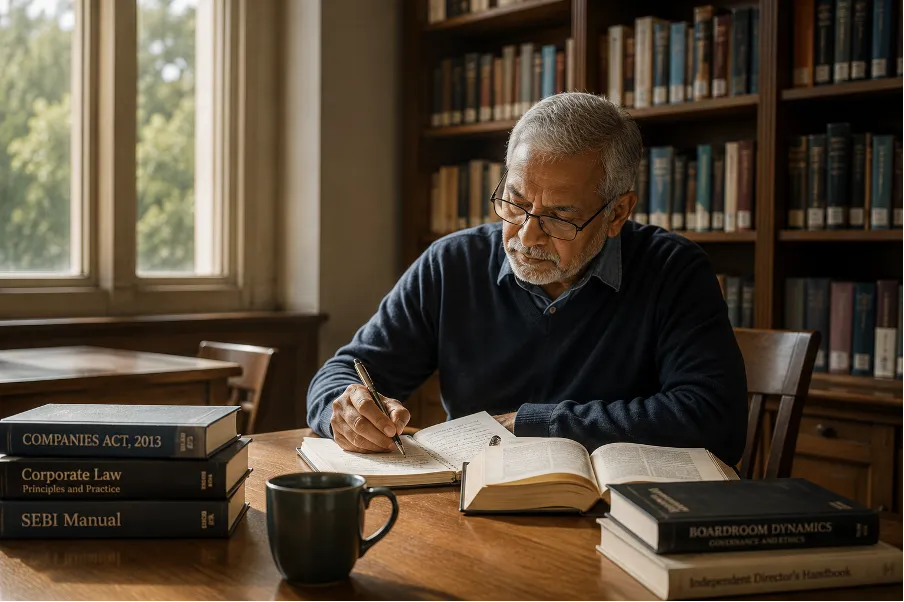
There is a particular kind of dread that has nothing to do with the difficulty of a question and everything to do with what failing it would mean.
I felt it in the weeks before I sat for an examination I had postponed for the better part of two years. Not dread of the syllabus. Dread of the verdict. Would I cross the line, or would I be found wanting? And if I failed, what would I tell myself? That my brain was no longer equipped for concepts that came easily to others? That whatever I had retained from four decades of boardrooms and balance sheets could not, in the end, be applied when it actually mattered? Was I still valuable, or was I quietly, politely, over the hill?
These are not comfortable questions at any age. At nearly seventy, with a reputation built over decades, they become considerably less comfortable.
I enrolled in late 2023 in a professional development programme built around the Independent Director certification. The reasoning was straightforward. India had—and still has—a significant shortfall of qualified Independent Directors, and a structured pathway into boardrooms seemed like a natural extension of a career spent advising and leading. I expected the certification to be a formality. Forty years of leadership experience, after all, surely counted for something.
The programme gave me far more than I had bargained for. It sharpened my finance instincts, introduced me properly to artificial intelligence—which I now use every day—and led me through a personal branding immersion that eventually became a genuine line of business for my consultancy. Somewhere along the way, the certification itself quietly slipped down my list of priorities.
I told myself I was too busy. That was not entirely untrue. But beneath the busyness lurked something less flattering: complacency. I had already extracted real value from the programme. The examination felt increasingly optional.
It remained optional until the Ministry of Corporate Affairs informed me that it would not remain so for much longer. I now faced a clear, immovable deadline: complete the certification by a fixed date or lose the opportunity permanently.
I sat with that email for a long time.
There is something about myself that doesn't appear on a CV.
I have spent much of my life as a late bloomer.
I led my class in primary school, drifted through some years of middle and senior school before finishing strongly, struggled through the early years of college before graduating with distinction, and got into the business school of my choice only on the third attempt. Failure—and the self-doubt that accompanied it—were not new to me. But there had always been another opportunity to recover.
This examination was different.
There would be no second chance.
That changed the texture of my preparation entirely. It is one thing to study with the comfort of a safety net. It is quite another to prepare knowing that a single sitting will determine the outcome, with no opportunity to redeem an off day or a misread question.
My ego, I discovered, had quietly attached itself to this examination in ways I had not fully admitted to myself. Having built a certain reputation over four decades, was I really prepared to put that reputation back on the line in unfamiliar, technical territory? There was a real temptation simply not to find out.
When Experience Failed Me
What surprised me most during preparation was not the volume of material. It was discovering, repeatedly, that my own experience was working against me.
One question has stayed with me more than any other. It asked for the three elements of the Guidelines for Professional Conduct that an Independent Director must follow under Schedule IV. I answered confidently, drawing on everything I knew about what good governance actually looks like in practice: an impartial mind, a sceptical disposition, intellectual curiosity, a sense of ownership. It felt right. It felt, if I am honest, like wisdom.
It was wrong. Not approximately wrong—entirely beside the point. The statute wasn’t asking what an Independent Director should feel or embody. It was asking for specific, enumerated obligations, in specific language: to uphold ethical standards of integrity and probity, to act objectively, to exercise responsibilities in good faith, to devote sufficient time and attention, to not allow extraneous considerations to compromise judgement, to not abuse the position to the detriment of the company, and to refrain from any action that leads to loss of independence. Seven precise clauses. None of them resembled my answer in any meaningful way.
The examination did not want my judgement. It wanted statutory precision. Logic versus learning. The confidence of memory versus the discipline of exact wording, exact clauses and exact numbers.
Forty years of leadership create a powerful self-perception: the belief that accumulated judgement is, in most situations, reliable. To discover that judgement could be not merely unreliable but actively misleading, on a subject I believed I understood reasonably well, was a quiet but genuine blow to the ego.
It is a particular kind of humbling to discover, late in life, that the very quality you have always considered your strength is, in a given moment, useless.
I had to relearn, in my late sixties, the basic discipline of trusting the text over my interpretation of it.
Age compounds the challenge in its own way. My memory span, I noticed, is shorter than it once was. I could absorb a section of the Companies Act comfortably enough on a first reading. Applying it correctly to an unfamiliar problem, weeks later under examination conditions, was something else entirely. It demanded not one pass through the material but two—a full second revision simply to keep the knowledge active enough for me to trust myself when it mattered.
Preparation became less about confidence than honest self-assessment. Chapter-wise quizzes and mock examinations became the only mirror I trusted. A poor score was not a setback; it was information, telling me precisely where my confidence was unearned.
Artificial intelligence became an unexpected ally—not as a shortcut, but as a conditioning coach preparing an out-of-shape athlete for a long-distance race: drilling me, quizzing me, correcting me, patiently, at whatever hour I happened to be working.
Choosing the Test
The real test of that endurance, though, had nothing to do with company law.
About a fortnight before the examination, I was admitted to hospital following a health episode that kept me there for several days. It cost me five precious days of preparation at the worst possible moment. Close family, understandably alarmed, suggested I simply let the examination go. It wouldn't really matter, I was told. There would be other paths.
In my own mind, it mattered a great deal.
I want to be honest about something here, because I think it is the most truthful part of this story.
Some part of me recognised, even as I lay in that hospital bed, that I now had a perfectly respectable excuse available to me. If I failed—or chose not to sit the examination at all—I could attribute it to ill health. No one would have questioned it. It would have seemed, in every visible sense, a reasonable explanation.
I did not want to use that excuse. Not because I doubted its validity, but because I would have known, privately, that it wasn't the real reason. The real reason would have been that I let the moment pass. That I chose comfort over confrontation. That when the test of whether I still had it in me arrived, I quietly declined to take it—and dressed that decision up in the language of circumstance.
So when I was discharged, I went back to my books with a different kind of resolve. One week remained. I decided it would have to be enough.
Something shifted in me during that final week, and it took me some time afterwards to understand what it was.
It was no longer about the second innings I had imagined back in 2023—the new line of business, the boardroom appointments, the professional reinvention. That ambition had quietly receded somewhere along the way, replaced by something smaller and more honest. I simply wanted this innings, the one I was already living, to count for something. I wanted to know that, when tested late and under real pressure, I still had the will and the capacity to meet the challenge.
I qualified.
I will not dwell on the score because I no longer think the score is the point. The point, as I understand it now, is this: I am capable, when I genuinely commit, of meeting an unfamiliar and difficult challenge, regardless of how unprepared my circumstances may seem. I proved that to myself when it mattered most.
I do not know whether this gets easier with age. I suspect it does not. What I have learned, instead, is that age changes the kind of courage required. At thirty, the fear is usually about competence: Can I do this? At nearly seventy, the fear is quieter and more existential: Am I still someone who does this, or has that version of myself already retired without telling me?
At thirty, the fear is usually about competence: Can I do this? At nearly seventy, the fear is quieter and more existential: Am I still someone who does this?
I had my answer, even if no one else would ever have known had I chosen differently.
No matter what the calendar says, some part of me is still willing to be tested, still capable of being recast and renewed when the moment demands it.
Join the conversation
Indranil Gupta
Founder Director | BrandNEW Associates
Indranil Gupta is a branding and communications professional with over four decades of experience working at the intersection of business strategy, institutional transformation, and brand meaning.
With an MBA from IIM Ahmedabad, he is the Founder-Director of BrandNEW Associates, a 13-year-old brand co-creation consultancy that partners with organisations navigating transition — from legacy businesses and learning institutions to social foundations and growth-stage enterprises.
Indranil’s work focuses on translating organisational intent into clarity. He helps leaders align purpose, narrative, design, and communication as part of long-term brand evolution, rather than short-term campaigns.
Over the course of his career, he has held senior leadership roles with global advertising networks including BBDO, Ogilvy, Lowe, and JWT in India, and later headed Lowe Contexture / Vahid Associates in the Middle East for over a decade. His work spans a wide range of global and Indian brands across education, healthcare, financial services, consumer goods, real estate, and social development.
In recent years, his practice has increasingly centred on institutions and not-for-profits — mentoring social entrepreneurs, advising education-led organisations, and supporting initiatives focused on livelihoods, inclusion, and environmental sustainability.
Indranil teaches Advertising to MBA students at XLRI, and Strategic Brand Management in executive education programmes and continues to engage in writing, mentoring, and dialogue around branding as a leadership and sense-making discipline.
Beyond the noise is the signal.
FF Insights: Sharpen your edge, Monday–Friday.
FF Life: Culture, ideas and perspectives you won't find elsewhere — Saturday.

Founding Fuel is sustained by readers who value depth, context, and independent thinking.
If this essay helped you think more clearly, you may choose to support our work.

Founding Fuel is sustained by readers who value depth, context, and independent thinking.
If this essay helped you think more clearly, you may choose to support our work.
Loading comments...
More by Indranil Gupta
Readers also liked

·FF Life
The Happiness We Keep Postponing
A reflection on joy, and why the ordinary day may be enough
HC

Haresh Chawla
Investor | Entrepreneur
The Happiness We Keep Postponing
A reflection on joy, and why the ordinary day may be enough
Investor | Entrepreneur

·Leadership & Organisation
The Blind Spots of India Inc
Disability inclusion, leadership imagination, and the limits of intent
SS

NJ
Subhashis Sinha & Nikunj Kumar Jain
The Blind Spots of India Inc
Disability inclusion, leadership imagination, and the limits of intent
Subhashis Sinha & Nikunj Kumar Jain

·Artificial Intelligence
India’s AI Gambit: The Choices That Will Define Power
Speed is not strategy. The real battle is over sovereignty, science and state capacity
FF

Founding Fuel
India’s AI Gambit: The Choices That Will Define Power
Speed is not strategy. The real battle is over sovereignty, science and state capacity
Explore more
Dive into other themes from our network.