The Battle for the Tata Inheritance
The struggle inside Tata Trusts is exposing a question that goes far beyond personalities: can an unusual compact between philanthropy, ownership and corporate power survive the loss of the steward who held it together?
28 September 2026· 17 min read
TL;DR
The turmoil within Tata Trusts reveals a deeper challenge: whether its unique fusion of philanthropy, ownership and corporate power can endure without the kind of singular steward Ratan Tata was. Tensions involving chairman Noel Tata, Mehli Mistry, Venu Srinivasan and the Tata Sons board expose unresolved boundaries between shareholder oversight and business autonomy. The Trusts control roughly two-thirds of Tata Sons, yet depend on its dividends to fund ambitious social programmes. Unlike Azim Premji’s separated corporate and philanthropic structures, Tata’s model entwines both. Its future hinges on clear governance, funding and preserving public purpose amid continuing struggles for institutional control.
Editor’s Note: Deep divisions inside Tata Trusts have drawn Noel Tata, Mehli Mistry and Venu Srinivasan into conflict—and spilled over into the Tata Sons board. Nearly two years after Ratan Tata’s death, the turmoil is exposing a much older question. Tata’s charitable trusts own roughly two-thirds of Tata Sons. They depend on the businesses for their philanthropic resources, while possessing extraordinary power over them. Can that unusual arrangement work without Ratan Tata at its centre?
Mehli Mistry had a relatively simple point to make.
As a trustee of the Tata Education and Development Trust (TEDT), he did not want its money being used to pay the legal bills from disputes engulfing Tata Trusts and Tata Sons. TEDT, he argued, was not a shareholder in Tata Sons and should remain insulated from those battles.
There was nothing simple, however, about Mistry’s place in this story. A low-profile Mumbai businessman who runs the M Pallonji group, Mehli was also a first cousin of Cyrus Mistry, the Tata Sons chairman ousted in 2016. Yet when the bitter Tata-Mistry battle erupted, Mehli stood firmly with Ratan Tata. The two had known each other for decades, and Mehli became one of Ratan Tata’s closest confidants. Ratan Tata brought him onto the boards of the two principal Tata Trusts in 2022 and later named him one of the executors of his will.
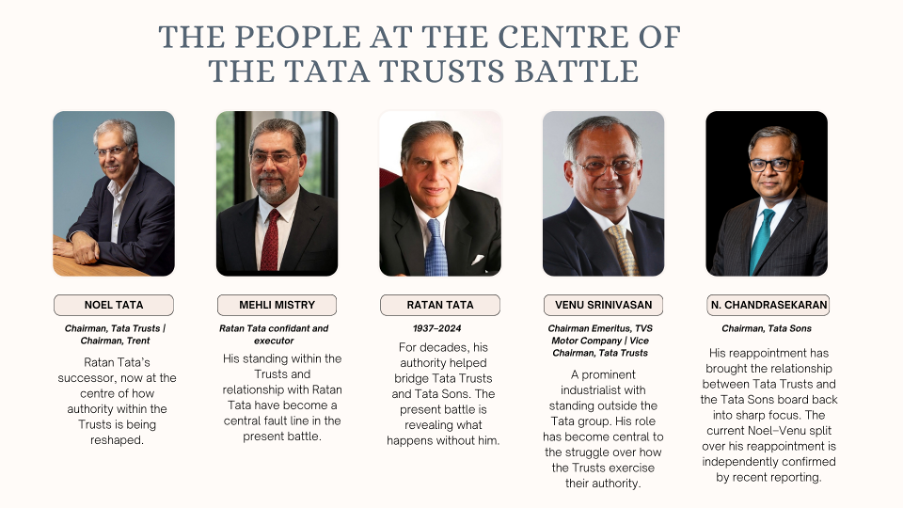
Now, after Ratan Tata’s death, Mehli himself was caught up in a struggle over the future of the institution his friend had once dominated. At its centre was Ratan Tata’s half-brother, Noel.
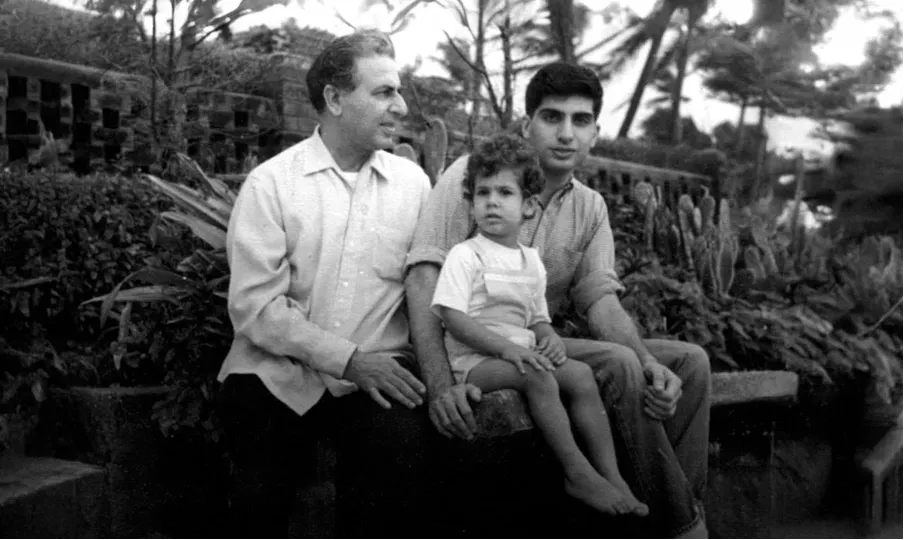
Noel Tata is Ratan Tata’s half-brother, twenty years his junior—the son of Naval Tata and his second wife, Swiss-born Simone Dunoyer, the formidable businesswoman who built Lakmé and later helped create Trent. The two brothers were never known to be particularly close. Noel built much of his career away from Ratan’s immediate circle, notably at Trent and Tata International. Ratan never publicly groomed him as his successor.
Yet after Ratan Tata died in October 2024, it was Noel who became chairman of Tata Trusts. The transition looked orderly. It would prove anything but. The resulting struggle has involved trustees, Tata Sons directors, regulators and lawyers. Inside the small Parsi community from which the Tata institution emerged, the public unravelling of these differences has caused considerable unease.
Noshir Dadrawala has spent more than four and a half decades as CEO of the Centre for Advancement of Philanthropy, an NGO that works on philanthropy and the governance of charitable institutions. He has watched the Tata Trusts closely over the years, including from within Mumbai’s small Parsi philanthropic world. To Dadrawala, the present turmoil is about more than personalities. The Tata arrangement was never merely a business empire with an unusually large charitable shareholder. It was, as he describes it, a “philanthropic empire”—an attempt to create wealth through enterprise and use that wealth for public purpose.
To understand what is at stake today, it helps to go back to the unusual compact on which Tata Trusts was built.
The original compact
The architecture was created in circumstances very different from today’s. Jamsetji Tata and the generation that followed him were building businesses in a country where the state had neither the resources nor the institutional capacity to address many of its most pressing needs. Jamsetji’s ambitions extended far beyond his textile mills: steel, hydroelectric power and an institution of advanced scientific education that would eventually become the Indian Institute of Science.
Jamsetji Tata had begun institutionalising the family’s philanthropy with the JN Tata Endowment in 1892. After Sir Ratan Tata’s death, the Sir Ratan Tata Trust was established under his will in 1919. The Sir Dorabji Tata Trust followed in 1932, when Dorabji left his fortune to a trust for charitable purposes.
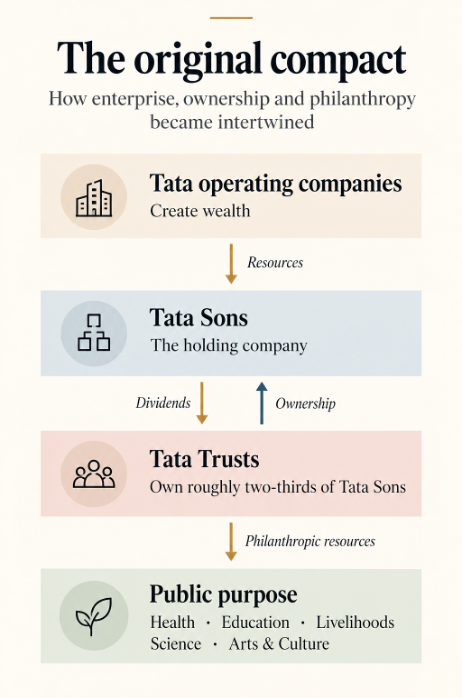
The arrangement produced something unusual. Private wealth had effectively been locked into public purpose. The Trusts would use their income for philanthropy, while remaining tied through their ownership to the businesses that generated the wealth.
Dadrawala argues that this was not originally some ingenious device for preserving corporate control. The philanthropic intent came first. The arrangement also belonged to its time: changes in Indian law would later make it difficult for newly created charitable trusts to accumulate corporate equity in quite the same fashion.
Other major Indian business families—the Birlas, Mahindras and Godrejs among them—built substantial traditions of philanthropy alongside their businesses. What made Tata unusual was the way the two became structurally intertwined: the charitable trusts themselves came to own the commanding stake in the corporate holding company.
There was another historical wrinkle. The Tata Trusts might own the commanding stake in Tata Sons, but that did not always mean their trustees could freely exercise the voting power that ownership ordinarily conveyed. Under the old Companies Act, the voting rights attached to company shares held in trust were exercised through a government-appointed Public Trustee. Ownership, in other words, did not automatically translate into unfettered control.
Private wealth had effectively been locked into public purpose.
For decades, however, that mattered less than it might have, partly because of the man at the centre.
JRD Tata presided over an extraordinarily decentralised federation. Sumant Moolgaokar at TELCO, Darbari Seth at Tata Chemicals, Russi Mody at Tata Steel and other formidable executives ran substantial fiefdoms. JRD did not exercise straightforward hierarchical authority over all of them. His power rested partly on something harder to codify: relationships, persuasion, longevity and an extraordinary reservoir of personal legitimacy.
Yet he also understood the compact between business and philanthropy with unusual clarity. The businesses had to make money—not simply because businesses existed to produce returns, but because the wealth they created ultimately supplied the charitable trusts with resources to pursue their public purpose.
In a 2022 interview at the Drucker School, historian Mircea Raianu, author of Tata: The Global Corporation That Built Indian Capitalism, made an important distinction. What made the Tata model significant was not simply that the controlling shareholding had been placed in charitable trusts, but what the Trusts then chose to do with it. Over the decades, they helped build institutions in science, education, healthcare and social research that India did not yet have.
Business and philanthropy were therefore intertwined from the beginning. JRD could hold the two together substantially through stewardship. Ratan Tata would inherit a very different challenge. As an earlier Founding Fuel essay explored, the larger question was whether stewardship could eventually be made institutional rather than depend on the exceptional steward.
Building a stronger centre
When Ratan Tata succeeded JRD in 1991, the group he inherited was populated by powerful satraps and independently governed companies in which Tata Sons did not always possess overwhelming ownership. Over the next decade, Ratan systematically strengthened the centre. Tata Sons increased stakes in important operating companies. Retirement rules weakened the hold of entrenched chieftains. A common Tata brand architecture created stronger links across the federation. The centre gradually acquired more institutional authority over what had historically been a loose collection of businesses held together substantially by the Tata name and JRD’s personal influence.
At almost exactly the same time, something consequential was happening on the other side of the Tata compact. In September 2000, Tata Sons adopted provisions giving the Tata Trusts the right to nominate up to one-third of its board and giving Trust-nominated directors affirmative voting rights on specified matters. The governance rights of the charitable controlling shareholder were becoming more explicit.
Three months later, amendments to the Companies Act brought the old Public Trustee mechanism to an end. The Trusts could now exercise directly the voting power attached to their enormous Tata Sons shareholding.
The proximity of the two changes is striking, though there is no reason to assume one caused the other. What matters is the outcome. By the beginning of the new century, Ratan Tata stood at the intersection of two institutions that had become considerably more powerful. Tata Sons was emerging as a stronger corporate centre, while the Tata Trusts had acquired clearer formal rights over Tata Sons and direct exercise of the voting power attached to their controlling stake. Ratan chaired both.
The arrangement worked remarkably well while the authority of the two institutions converged in one person. The real test would come when they separated.
But before that happened, Ratan Tata would transform the other half of the compact.
Ratan Tata’s second act
Ratan Tata stepped down as chairman of Tata Sons at the end of 2012. It took him a little time to make the transition.
In 2012, when I was Founding Editor of Forbes India, I worked closely with my colleague Prince Mathews Thomas on a cover story about what Ratan Tata intended to do after stepping down from Tata Sons. His imagination was no longer confined by the boundaries of the business group—or even by India.
In that same Forbes India cover story, R.K. Krishna Kumar, one of Ratan Tata’s closest associates, offered another window into that shift. Tata itself had become a global institution—through Tetley, Corus, Jaguar Land Rover and TCS—and Ratan Tata’s philanthropic imagination was widening too. The $50 million gift to Harvard Business School to fund Tata Hall drew criticism at home and later came under scrutiny from Parliament’s Public Accounts Committee, which questioned the use of charitable funds for a wealthy foreign university. But Krishna Kumar’s defence pointed to the larger change: Tata’s idea of where it could legitimately have an impact was no longer confined to India.
The HBS debate offered an early glimpse of how Ratan Tata was beginning to rethink the Trusts. By 2016, that transformation was well under way.
Debasis Ray arrived at Tata Trusts in August that year with an unusual vantage point on the Tata system. He had headed communications at Tata Motors from 2005, before moving to Tata Sons in 2011 to lead group communications. Five years later, he crossed over to the Trusts.
What Ray encountered was, in his recollection, a “many-spangled” organisation, with talented people pursuing ambitious programmes across health, nutrition, livelihoods, sanitation, technology, arts and culture. Yet surprisingly little was known about the Trusts outside. Even within the organisation, people working in one area sometimes knew little about what was happening elsewhere. One of Ray’s instincts was to “let the sunlight in”.
Part of the reason was that Tata Trusts itself was changing. The dozen-odd individual trusts remained legally distinct, but were increasingly working as one organisation. Talent could be pooled and programmes designed across trusts. Tata Trusts was becoming more than an umbrella name.
The deeper change was in how Ratan Tata thought philanthropy should work. Historically, the Trusts had largely been grant-makers. Organisations approached them with proposals; the Trusts funded work that fitted their priorities, monitored it and eventually exited. Ratan Tata wanted something more interventionist.
The question was whether an intervention could produce change that lasted after the Trusts withdrew. Grants remained important, but Tata Trusts people increasingly worked on the ground, designed programmes and collaborated directly with NGOs and governments.
The canvas became extraordinarily wide. There were livelihood programmes across tribal districts. In sanitation, the Trusts worked alongside the government on Swachh Bharat Gramin, putting people on the ground to support stretched district administrations. Nutrition attracted Ratan Tata because an intervention in the early years of a child’s life held out the possibility of intergenerational change. Health became increasingly important. So did technology—not technology for its own sake, but whatever tools might help solve the problem at hand.
And there were fields far removed from conventional development. As Deepika Sorabjee, then head of Arts and Culture at Tata Trusts, told Founding Fuel’s Kyra Jani, the Trusts backed Shivendra Singh Dungarpur’s Film Heritage Foundation at a formative stage, helping preserve a disappearing part of India’s cinematic inheritance.
Behind these programmes, Ray remembers unusually capable professionals running different portfolios. Some, he says, were “just brilliant”. Proposals could produce intense internal arguments before large commitments eventually reached the trustees and Ratan Tata.
The pressures that followed were partly a consequence of the scale of what the Trusts now wanted to do—and of some bets not unfolding as planned.
Cancer care was the most striking example. Ratan Tata had made it a major priority, with an ambitious plan to expand access to cancer treatment beyond the big metropolitan centres. The model envisaged state governments sharing the cost of creating the hospital infrastructure, with Tata Trusts bringing in substantial resources of its own.
But, as Ray recalls it, the government contribution did not materialise to the extent anticipated. The Trusts ended up carrying much more of the financial burden themselves. Cancer care was capital-intensive, and the commitment could not simply be unwound once projects were under way. The result, Ray says, was that the Trusts became “overstretched on the cancer side”.
That had consequences elsewhere. With resources committed to large priorities such as cancer care, smaller programmes came under pressure. Arts and culture and sports were among the areas where spending was squeezed. By around 2016-17, Ray recalls, the Trusts were stretched enough that another large proposed intervention in nutrition could not be taken on.
Here the peculiar Tata architecture begins to matter. The Tata Trusts are not simply foundations sitting atop diversified endowments. They own roughly two-thirds of Tata Sons. Their ability to pursue an expanding philanthropic mission is therefore intimately connected to the fortunes of the holding company at the apex of the Tata group.
Dadrawala describes the resulting responsibility in unusually simple terms. The trustees have two fiduciary duties: they must safeguard the source of wealth that sustains the Trusts, and they must ensure that the money is used for the charitable purposes laid down by their founders.
Those responsibilities need not conflict. For much of Tata history, they reinforced each other. But they create an unusual interdependence. The Trusts control Tata Sons, even as they depend upon Tata Sons to generate the resources with which they pursue their philanthropic purpose. As philanthropic ambition grew, the reliability of that flow mattered more.
And then the two chairs separated.
When the two chairs separated
Ratan Tata understood that separating the chairmanship of Tata Sons from that of Tata Trusts would change the way the system worked. As he prepared to retire from Tata Sons, he spoke about the need to clarify the role of the Trusts once the two institutions no longer had the same chairman.
For years, Ratan had chaired both. Differences between Tata Sons and its controlling shareholder could ultimately be reconciled by someone who carried authority on both sides. Once the two chairs separated, that could no longer be taken for granted.
Ratan tried to address the problem through a more explicit governance framework. The Trusts already had the right to nominate up to a third of the Tata Sons board, and their nominee directors had affirmative voting rights. In 2014, two years after Cyrus Mistry took over, the articles were amended again. Key matters—including Tata Sons’ five-year strategy, annual business plan and major investment and financing decisions—were now explicitly required to come before the board. The Trust-nominated directors therefore had a formal say in decisions that went to the heart of how Tata Sons deployed capital and set strategy.
The rules clarified where the Trusts had a voice. They could not settle how that voice should be used. Where did the legitimate oversight of a controlling shareholder end and the authority of the Tata Sons board begin? And what happened when the two saw the interests of the Tata system differently?
Cyrus Mistry would provide the first real test.
The battle that erupted in 2016 has usually been described as a struggle between two men: Ratan Tata versus Cyrus Mistry. That framing misses something. Behind the personalities stood two institutions with legitimate but potentially different responsibilities.
Mistry confronted businesses and investments across the group that he believed required difficult restructuring and harder capital-allocation choices. The tension was real. The Trusts depended on a healthy Tata Sons to sustain increasingly ambitious philanthropic commitments. The Tata Sons board, meanwhile, had to make its own judgements about restructuring, capital allocation and the long-term competitiveness of the group. What happened when those priorities pulled in different directions?
By June 2016, the difficulty was visible inside Tata Sons itself. Its Nomination and Remuneration Committee, while reviewing Cyrus Mistry’s performance, flagged the need for greater clarity about the relationship between the Tata Sons board, Tata Trusts and the operating companies. At issue was something fundamental: how much freedom did the chairman of Tata Sons have to run the group when the controlling shareholder had its own expectations about strategy and performance?
Four months later, that unresolved tension burst into the open when the Tata Sons board removed Mistry as chairman.
Ratan Tata ultimately prevailed in the confrontation. But the battle left behind a harder question: what happens when Tata Trusts and Tata Sons disagree, and there is no longer one person with the authority to bridge the divide?
That is no longer a historical question. Tata Sons remains heavily dependent on TCS for its dividend income. But TCS itself is navigating a profound shift in the technology-services business, driven in part by AI. At the same time, Tata Sons is committing large amounts of capital to businesses such as Air India, Tata Digital and Tata Electronics. In FY26, the dividend Tata Sons received from TCS fell 12%. The underlying tension has not disappeared: how much cash can move up the chain, and how much needs to remain in the businesses to finance their future?
A different experiment
There was another way to think about the problem.
Azim Premji had spent decades turning Wipro into one of India’s most successful technology companies. But alongside the business ran a very different preoccupation.
At the inaugural Forbes India Philanthropy Awards in Bengaluru in 2012, Narayanan Vaghul, the former chairman of ICICI and a longstanding independent director on Wipro’s board, recalled Premji calling him before a board meeting, agitated by something seemingly mundane: schoolteachers were being pulled away for election duty. Premji could not understand why a system struggling to educate children would routinely take teachers out of classrooms.
The concern was not new. Premji told my Forbes India colleague Mitu Jayashankar in 2012 that, as a student at Stanford in the 1960s, he had once hoped to work for an international development agency. His father’s sudden death brought him back to India to run the family business. But the idea that wealth carried obligations beyond the business stayed with him.
Over time, that impulse became an institution. The Azim Premji Foundation concentrated much of its work on education, building a professional organisation rather than a conventional grant-making foundation. And as the scale of Premji’s giving grew, another question became important: how could the fortune created by Wipro finance that work long after the founder was gone?
Premji had one advantage the Tata founders never had: hindsight. By the time he began building institutions around his philanthropy, Tata Trusts had been operating for decades. Premji’s team studied that experience closely. They admired what the Tatas had created, but they did not simply replicate it.
One of their choices concerned the money itself.
The Foundation would require funding for as long as it existed. So Premji created an endowment whose job was not merely to hold his donated Wipro shares, but to preserve and grow their value over time. The Foundation and the other philanthropic institutions would depend upon that endowment for their funding. The investment organisation therefore had to think in decades, not annual grant cycles.
That led to an unusual decision. The endowment was set up as a fully tax-paying entity. It could have sought the advantages of tax-exempt status. Instead, Premji’s team accepted the tax cost because they wanted greater freedom to invest in equities and other assets that could generate stronger long-term returns.
The Tata experience had informed that choice. Premji’s team had studied the investment constraints under which Tata Trusts operated and concluded that greater freedom to invest in equities could produce better long-term returns—and ultimately more money for philanthropy.
There was a second difference, even more important to the Tata story.
Premji progressively committed large portions of his Wipro wealth irrevocably to philanthropy. By March 2016, the endowment had a corpus of about $9 billion. But not all the Wipro wealth from which it benefited carried voting rights. At the time, the Trust directly owned about 16% of Wipro and had the economic interest in another 22%, while voting rights over that latter portion remained with the principal owners.
By 2019, Premji had committed economic ownership worth about $21 billion, representing 67% of Wipro, to philanthropy—placing the scale of his giving among the largest philanthropic commitments anywhere in the world. This was not a wealthy industrialist setting aside a portion of his fortune for charity. Premji was committing the greater part of the wealth he had created to institutions intended to pursue a public purpose beyond his lifetime.
The distinction was deliberate. The wealth created by Wipro would sustain the philanthropic institutions. But those institutions would not become responsible for governing Wipro.
That was very different from Tata.
Tata Trusts own roughly two-thirds of Tata Sons. The success of Tata Sons provides the resources that sustain their philanthropy. But their ownership also gives the Trusts substantial rights over the company itself, including representation on the Tata Sons board.
Premji separated those roles. Wipro would remain a commercial enterprise. A professionally managed endowment would turn the wealth it had created into a permanent pool of philanthropic capital. The Foundation and other institutions would pursue the social mission. The philanthropy did not need to become the controlling steward of the company that had created the fortune.
That design matters even more today. Wipro, like TCS, is confronting slower growth and the disruption of AI. The endowment itself began overwhelmingly with Wipro wealth. But it was designed to diversify that wealth over time rather than leave the philanthropic institutions permanently dependent on the fortunes—or the dividend stream—of a single company. How far that diversification has progressed therefore matters.
That does not mean Premji solved the problem of succession. He is still alive and remains closely identified with the institutions he created. We do not yet know how well they will preserve their purpose, renew their leadership and make difficult choices for a generation without him.
But his successors will inherit a different problem.
At Tata Trusts, succession is not only about who carries forward the philanthropy. It is also about who exercises the Trusts’ power as the controlling shareholder of Tata Sons, how that power is shared among trustees, and where the boundary lies between the Trusts and the Tata Sons board.
Tata Trusts is confronting both questions at once: how to carry forward a philanthropic mission after Ratan Tata, and how to exercise the corporate power that comes with funding it.
For Tata Trusts, that test became real in October 2024.
After Ratan Tata
The tensions were already there. Ratan Tata’s death removed the person who had long held the different parts of the Tata system together. And for all the attention he had paid to defining the relationship between Tata Trusts and Tata Sons, he left no clear succession plan for his own role at the Trusts.
Noel Tata’s elevation as chairman of Tata Trusts settled one question, but not the larger one of where authority would now lie. Noel had the Tata name, knew the group well and had built his own record over decades, most notably at Trent. But Ratan Tata’s authority had rested on much more than the office he occupied. It had grown out of relationships and loyalties built over decades. Those could not simply pass to his successor.
Ratan Tata’s authority had grown out of relationships and loyalties built over decades. Those could not simply pass to his successor.
Some of those relationships now mattered enormously. Ratan Tata had brought powerful individuals into the Trusts and placed considerable confidence in them. Mehli Mistry was perhaps the clearest example. He had been Ratan Tata’s confidant, trustee and executor, and his standing within the Trusts was closely tied to that relationship.
Noel came from a very different place. He had spent much of his career outside Ratan Tata’s immediate circle and had built his own record at Trent and Tata International. He was, in important ways, his own man. There was no reason to assume that he would see his job as preserving all the arrangements Ratan Tata had left behind.
That made the transition more complicated. Mehli could point to Ratan Tata’s confidence in him; Noel had the chair and his own view of how the institution should be run. The question after Ratan Tata was therefore not simply who would succeed him. It was what would happen to an institution in which so much authority had rested on relationships that could not themselves be inherited.
The struggle over what should survive Ratan Tata has spilled beyond the boardroom. Within Mumbai’s small Parsi community, where the Tata name carries a significance that goes well beyond business, the turmoil at the Trusts has caused considerable unease.
Dadrawala is particularly critical of the influence exercised by trustees he regards as “outsiders”, including Venu Srinivasan, chairman emeritus, TVS Motor Company and vice chairman, Tata Trusts. In his view, people brought into the Trusts by Ratan Tata were entrusted with stewardship of an institution whose history and ethos long predated them; they were not meant to become competing centres of power after his death.
Dadrawala’s anger is revealing, even if one does not share his view of “outsiders”. The Tata Trusts are public charitable institutions; they do not belong to the Parsi community. Nor does being close to Ratan Tata give anyone a special claim over them.
Yet it would be a mistake to ignore the disquiet within the community. The Tata name has been woven into Parsi life for generations, just as Parsi philanthropy helped shape the institution itself. For some in the community, the battle at the Trusts therefore feels unusually personal. It is not only about who sits on which board, but about who can be trusted with an inheritance they regard as part of their own history.
That makes the need for clear rules more important, not less.
There is an irony in how the story has come full circle. For many years, the Tata Trusts could not freely exercise the voting rights that came with their Tata Sons shares. Those rights were exercised through a government-appointed Public Trustee. That changed in 2000, giving the Trusts much greater freedom to exercise their power as Tata Sons’ controlling shareholder.
But the Trusts themselves remained charities governed by Maharashtra’s public trust laws. That is why the Charity Commissioner matters today. A dispute over who can serve as a trustee—or how the Trusts themselves are governed—can ultimately affect how they exercise their power over Tata Sons.
But they remained charitable trusts subject to Maharashtra law. The current battle has brought that distinction sharply back into view.
What remains of the philanthropic ambition?
For all the turmoil at the top, Debasis Ray remembers something quite different about his years at Tata Trusts: the people and the work. He remembers unusually capable professionals arguing passionately about nutrition, livelihoods, sanitation, health, culture and other difficult public problems. There were funding pressures and programmes that had to be reconsidered. But there was also palpable energy inside the organisation.
Dadrawala offers a more sobering contemporary counterpoint. He has written to the Tata Trusts that he wishes to return their grant of ₹15 lakh for a research study being undertaken by CAP, the NGO he helms. His experience may not be representative. But it is hard not to set it against Ray’s memories of an organisation brimming with energy and ideas a decade ago—and wonder how much of that energy survives today.
That question matters because the argument over Tata Trusts can easily become an argument about Tata Sons. The Trusts own roughly two-thirds of the company, and that gives their trustees enormous power. But corporate control was never the reason the Trusts were created. The businesses generated the wealth; the Trusts were meant to put it to work.
Corporate control was never the reason the Trusts were created. The businesses generated the wealth; the Trusts were meant to put it to work.
Ratan Tata pushed the Trusts well beyond conventional grant-making. The ambition sometimes outran the resources available, as cancer care demonstrated. But Ray remembers an organisation willing to attempt difficult things at scale.
Noel Tata has inherited a very different moment. He has to deal with a divided group of trustees, an unsettled relationship with Tata Sons and questions about how much of the order Ratan Tata left behind should survive him. He may choose to answer those questions very differently from his half-brother. Indeed, there is no reason to assume that preserving Ratan Tata’s way of doing things is how Noel sees his job.
Once the battles over trustees, board seats and Tata Sons are settled, what kind of Tata Trusts will be left behind?
The irony is that the Tata model can look both antiquated and oddly contemporary. A charitable trust exercising decisive influence over a global corporate group sits uneasily with modern ideas about independent boards and shareholder accountability. Yet an ownership structure in which much of the wealth created by business ultimately flows to public purpose speaks directly to today’s debate about whether companies exist only to maximise returns to shareholders.
That tension is no longer theoretical. It is playing out inside the Tata system itself. The recent rupture between Noel Tata and Venu Srinivasan is telling. Both sit on the Tata Sons board as nominees of Tata Trusts. Yet when Noel opposed N. Chandrasekaran’s reappointment as chairman, Venu backed it. Behind that disagreement lies a larger question: how far should Tata Trusts go in exercising the power that comes with its controlling stake, and how much room should the Tata Sons board have to run the business?
The question after Ratan Tata is what Tata Trusts will do with both the power and the purpose it has inherited.
More than a century ago, the Tatas made an unusual choice: much of the wealth created by their businesses would eventually belong not to succeeding generations of the family, but to charitable trusts. That arrangement gave the Trusts enormous resources for philanthropy. It also gave them extraordinary power over the businesses that generated those resources.
The question after Ratan Tata is what Tata Trusts will do with both the power and the purpose it has inherited.
Join the conversation
Indrajit Gupta
Co-founder and Director | Founding Fuel
Indrajit Gupta is a business journalist and editor with over two decades of experience. He was the Founding Editor of the Indian edition of Forbes magazine. Within four years of its launch, Forbes India became the most influential magazine in its space.
He is the co-founder and director at Founding Fuel.
He has served in leadership positions at many of the leading media brands in the country. Before taking up the assignment to start up the India edition of Forbes magazine, Gupta was the Resident Editor of The Economic Times in Mumbai and before that, the National Business Editor of The Times of India.
Over the years, Gupta has built a reputation for grooming talent and creating highly energised and purposeful newsrooms. He has interviewed several leading global thought-leaders and business leaders including CK Prahalad, Ram Charan, Wayne Brockbank, Sumantra Ghoshal, Carlos Ghosn and Nitin Nohria, and also led cutting-edge joint research-based projects with McKinsey & Co, The Great Place to Work Institute, Boston Consulting Group, KMPG and Coopers & Lybrand.
He won the Polestar journalism award in 2010 and was awarded the Chevening fellowship by the British Foreign office in 1999. Gupta is an alumnus of the SP Jain Institute of Management and Research, Mumbai and a B.Com (Hons) graduate from St Xavier's College, Calcutta.
Gupta teaches a course on Business Problem Solving at his alma mater. He writes a column named Strategic Intent in Business Standard’s edit page. He lives in Mumbai with his wife and two young daughters.
Beyond the noise is the signal.
FF Insights: Sharpen your edge, Monday–Friday.
FF Life: Culture, ideas and perspectives you won't find elsewhere — Saturday.

Founding Fuel is sustained by readers who value depth, context, and independent thinking.
If this essay helped you think more clearly, you may choose to support our work.

Founding Fuel is sustained by readers who value depth, context, and independent thinking.
If this essay helped you think more clearly, you may choose to support our work.
Loading comments...



Readers also liked

·Leadership & Organisation
The Battle Cry in the Boardroom
What looks like motivation—war footage, heroic narratives, calls to crush the competition—is often something else entirely: a system of thinking that rewires how organisations see markets, customers, and themselves
KA

Kavi Arasu
Leadership and Talent Development Professional
The Battle Cry in the Boardroom
What looks like motivation—war footage, heroic narratives, calls to crush the competition—is often something else entirely: a system of thinking that rewires how organisations see markets, customers, and themselves
Leadership and Talent Development Professional

·Artificial Intelligence
India’s AI Gambit: The Choices That Will Define Power
Speed is not strategy. The real battle is over sovereignty, science and state capacity
FF

Founding Fuel
India’s AI Gambit: The Choices That Will Define Power
Speed is not strategy. The real battle is over sovereignty, science and state capacity

·Economy, Policy & Society
US Shutdown Theater: Starring US Congress, Directed by US Constitution?
Britain and India survive budget battles. The US turns them into a national pastime
SG

Sachin Garg
Independent Public Policy Consultant
US Shutdown Theater: Starring US Congress, Directed by US Constitution?
Britain and India survive budget battles. The US turns them into a national pastime
Independent Public Policy Consultant
Explore more
Dive into other themes from our network.