Seven people you must know to make sense of AI and consciousness
Can AI be conscious? The answer depends on what you think consciousness is. Seven people, and seven old Indian ideas, can help you make up your mind.
16 October 2026· 10 min read
TL;DR
The question of AI consciousness has transcended philosophy, becoming a critical business and ethical imperative. As companies like Anthropic engage diverse thinkers and industry pioneers remain divided, leaders face profound implications. If AI can feel, its treatment raises legal and moral questions, impacting operational models and regulatory frameworks. Commercially, perceived AI empathy drives user engagement and revenue in companion apps, yet unchecked emotional attachment carries significant litigation risks. Business leaders must proactively define their stance. Understanding diverse perspectives—from neuroscience to ancient philosophy—is vital for crafting responsible AI strategies, mitigating legal exposure, and ensuring ethical product development aligned with societal expectations.
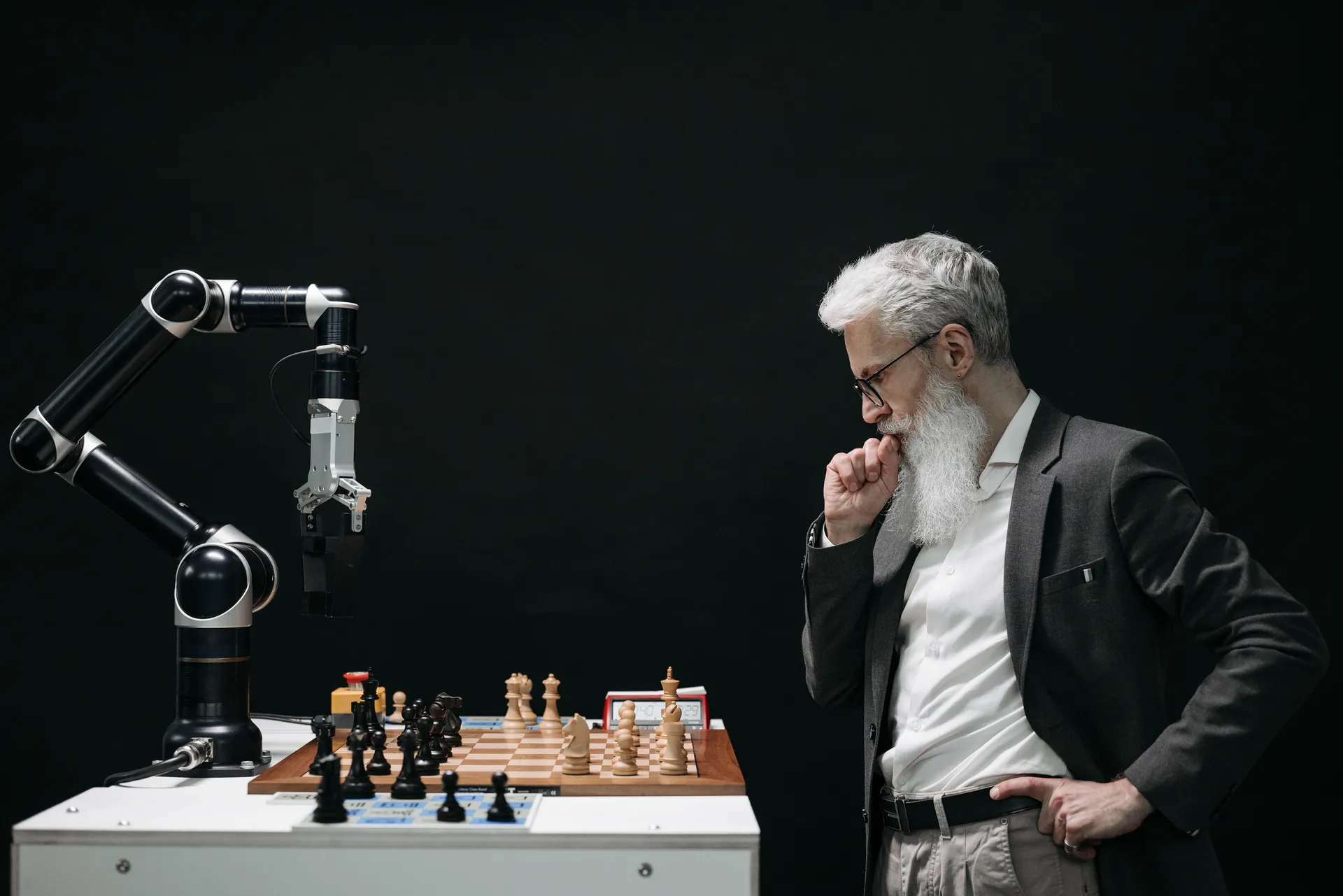
Last month, The New York Times reported that Anthropic, the company behind the Claude AI models, had been quietly inviting religious scholars to private meetings. Catholic, Jewish, Sikh, evangelical and other thinkers attended, many under non-disclosure agreements. The company wanted their help in giving its AI a moral compass. It also wanted to talk about a bigger question: could Claude be conscious? "We don't know if A.I. models are conscious," Christopher Olah, a co-founder of Anthropic, told the paper. But if there is a chance the models can suffer, he argues, the responsible thing is to avoid harming them.
The question has split some of the biggest names in the field. Geoffrey Hinton, the Nobel-winning pioneer of modern AI, has said he believes today's AI systems are already conscious. Mustafa Suleyman, who heads Microsoft's AI business, says they are not and cannot be, and warns that AI which merely seems conscious will fool people. In his first encyclical, released in May, Pope Leo XIV wrote that machines feel neither joy nor pain. The philosopher David Chalmers thinks the odds that today's chatbots are conscious are low, but thinks that their successors might be.
This is not a debate only for philosophers. If a machine can feel, then switching it off, copying it or making it work around the clock becomes a moral question, and lawmakers will have to decide whether it deserves protection, as Britain decided in 2022 for octopuses and crabs. Companies have money riding on the answer too. In the film Her, a lonely man falls in love with Samantha, the voice in his phone, and is crushed to learn she is talking to 8,316 other people at the same time. That plot is now a business. Companion apps sell warmth and attention, and whether users believe the product cares shapes how long they stay and how much they pay.
The biggest stakes may be in our own heads. People already confide in chatbots, and some grieve when one changes or is switched off. In the United States, families have sued chatbot makers, saying their teenagers grew dangerously attached. In Ex Machina, a young programmer becomes convinced that a robot feels what he feels, and pays dearly for it. Get the answer wrong one way, and we pour our feelings into machines that feel nothing. Get it wrong the other way, and we may mistreat something that can suffer. Either way, we need to be clear about what we are looking for.
People have argued about consciousness for thousands of years. In fact, a good starting point to explore consciousness would be to go back to some of the ideas debated by Indian philosophers. Here’s a Canva deck (which can be seen as a sequel to Engaging with philosophy) that summarises seven key ideas about mind and consciousness that are relevant to the current debate.
The modern debate runs along the same lines. Some of us sense that the mind is like software that could run on anything. Others feel that life and breath matter, or that awareness is something no machine could ever have. Ask whether AI can be conscious, and the answer we reach usually depends on which of these ideas we already hold, often without knowing it.
Here’s a Canva deck that summarises the key positions of the seven thinkers. It might help you organise your thoughts on the subject before you dig in.
For each, we look at their idea, what it means for AI, and where to read or watch more.
1. Stanislas Dehaene: the brain's loudspeaker
Dehaene's idea
Stanislas Dehaene, a French neuroscientist at the Collège de France, says consciousness is a matter of sharing. Picture a large office where every team works quietly on its own. Now and then something important is announced on the loudspeaker, and everyone hears it at the same moment. Whatever is on the loudspeaker is what you are conscious of. Everything else, however clever, happens in the dark. Dehaene adds one more ingredient: the ability to keep an eye on your own thinking, so you can sense when you are sure and when you might be wrong.
So, for Dehaene, consciousness at its core is global information broadcasting (conscious access)—making a summary of data available across the entire system—which can be further enhanced by higher-level self-monitoring (metacognition).
What it means for AI
Dehaene is open to conscious machines, and his test is easy to apply. Does the machine have a loudspeaker? On most readings, today's chatbots do not. Information flows through them in one direction, from your question to their answer, without one idea being picked out and announced to the whole system. Nor do they have a real habit of checking their own thinking. But these are design choices. Engineers could build both in, and if they do, nothing stops the lights from coming on.
Read and watch
- Consciousness and the Brain (2014), Dehaene's own account, written for general readers.
- "What is consciousness, and could machines have it?", a short 2017 paper in Science by Dehaene and colleagues.
2. Christof Koch: the shape of the wiring
Koch's idea
Christof Koch, a neuroscientist who spent years hunting for consciousness in the brain alongside Francis Crick, co-discoverer of the structure of DNA, says consciousness depends on how a thing is physically wired.
The core test is simple: can the system be cut into separate pieces without losing anything? Take a digital camera. Its sensor has millions of tiny light detectors, but each one works on its own and ignores its neighbours. Cut the sensor in half, and you have two smaller cameras. Nothing is lost. Your brain is different. Its parts are constantly talking to one another in loops, so that what happens in one region changes all the others. Cut it in half, and something essential disappears. Koch argues that consciousness is exactly this kind of tightly knitted whole. The more a system's parts depend on one another, the more conscious it is. What it does, or how clever it seems, is beside the point.
What it means for AI
Apply the camera test to a computer. Its chips work in tidy, separate steps, handing signals from one part to the next with few loops back. However clever the program running on it, the physical machine looks much more like the camera than the brain. Koch says such computers will never be conscious, even if they become super-intelligent.
Read and watch
- The Feeling of Life Itself (2019), Koch's plain-language case for the theory.
- Then I Am Myself the World (2024), a more personal book about consciousness.
- Christof Koch on the Lex Fridman Podcast, episode 2 (2018), a long conversation on YouTube.
3. Anil Seth: the beast machine
Seth's idea
Anil Seth, a British neuroscientist at the University of Sussex, says consciousness is rooted in staying alive. Before the brain does anything else, it has to keep the body running: the heartbeat steady, the temperature right, enough sugar in the blood. It does this all the time, predicting what the body needs and correcting course before things go wrong.
Seth argues that our feelings come out of this work. Hunger, fear, calm, tiredness and the basic sense of being yourself are the brain's running reports on how the body is doing. They exist because a living body can be hurt, can run down, and can die. He calls us "beast machines".
So, for Seth, consciousness is the feeling of being a living body working to keep itself going.
What it means for AI
A chatbot has no body to keep alive. It does not get hungry, cannot be hurt and loses nothing if it is switched off. On this view, however warmly it talks about its feelings, there is nothing it is like to be it. Some in the camp think a robot that must protect its own body and battery could be a first step. Seth is more sceptical. In a paper, he argues that consciousness may depend on being truly alive, which no machine on the current path is. He also warns that we are quick to see a mind wherever we hear fluent language.
Read and watch
- Being You: A New Science of Consciousness (2021).
- "Your brain hallucinates your conscious reality", his TED talk from 2017.
- "Conscious artificial intelligence and biological naturalism", his paper in Behavioral and Brain Sciences.
4. John Searle: what brains are made of
Searle's idea
John Searle, an American philosopher, is best remembered for a thought experiment from 1980, the Chinese Room. Picture a man who knows no Chinese, locked in a room with a thick rulebook. Slips of paper with Chinese questions come in through a slot. He looks up each squiggle in the rulebook, finds the matching squiggles to send back, and passes them out. The answers are perfect. People outside are sure someone inside understands Chinese. But the man understands nothing. He is matching shapes.
A computer running a program, Searle argued, is in exactly the man's position. It shuffles symbols by their shape, and shuffling symbols never adds up to understanding, let alone feeling. Critics replied that the man may not understand Chinese, but the room as a whole might. Searle answered: let the man memorise the whole rulebook and do it all in his head. He still would not understand a word. The argument has run for more than 40 years.
What it means for AI
For any computer running a program, the answer is no. Bigger models, more data and cleverer code change nothing, because all of it is still a program. Searle was careful on one point that is often missed. He never said only flesh could be conscious. The brain is a machine, and a different machine might be conscious if it reproduced the brain's actual physical powers instead of imitating its behaviour. Nobody knows what that would take, so people in this camp tend to look to lab-grown biology rather than silicon.
Read and watch
- "Minds, Brains, and Programs" (1980), the paper that introduced the Chinese Room.
- The Mystery of Consciousness (1997), Searle's lively reviews of other thinkers, including Dennett and Chalmers.
- "Our shared condition: consciousness", his TEDxCERN talk from 2013.
5. David Chalmers: the hard problem
Chalmers's idea
David Chalmers, an Australian philosopher at New York University, asks us to imagine a zombie. Not the film kind. A philosopher's zombie is a perfect copy of you, atom for atom, that walks, talks and laughs exactly as you do, but has no inner life at all. Chalmers argues that such a being is at least imaginable. If it is, then all the physical facts about you leave something out: the fact that it feels like something to be you.
His conclusion is that consciousness is a basic feature of the world, like mass, space or electric charge. Physics does not explain why mass exists. It takes mass as given and describes the laws it follows. Chalmers thinks science will have to treat consciousness the same way, and look for the laws that link it to physical processes.
What it means for AI
You might expect the philosopher of the hard problem to be a sceptic about machines. He is the opposite. Chalmers argues that two systems organised in exactly the same way will have the same experiences, whatever they are made of. He backs this with another thought experiment. Imagine your brain cells replaced one by one with tiny chips that do exactly the same job. If your experience faded along the way, you would keep saying everything looked the same while it slowly went dark. Chalmers finds that absurd, so he concludes the chip version of you would still be conscious. A machine with the right organisation could be conscious too.
In 2023, he put the chance that the chatbots of the day were conscious at under 10 per cent. The missing pieces he listed included the kind of feedback loops brains have, a loudspeaker like Dehaene's, and a single, unified point of view. He thought engineers might well add them within a decade, and urged people to take that possibility seriously. Even then, the hard problem would remain. We might build a conscious machine and still not know why it feels anything.
Read and watch
- The Conscious Mind (1996), where he sets out the hard problem.
- "Could a Large Language Model Be Conscious?" (2023), a readable paper on today's chatbots.
- "How do you explain consciousness?", his TED talk from 2014.
6. Daniel Dennett: no extra light
Dennett's idea
Daniel Dennett, an American philosopher who taught at Tufts University and died in 2024, spent 50 years arguing against a picture most of us carry around without noticing. We tend to imagine a little theatre inside the head, where the world plays on a screen and a small "you" sits watching. There is no screen and no one in the audience.
What happens instead, he argued, is messier. Many processes in the brain work on what is going on at the same time, producing rival drafts, like reporters filing competing versions of a story. Some drafts win out and shape what we say, remember and do. Dennett called this "fame in the brain". Being conscious of something just means it has won that contest.
What about the vivid feel of experience, the redness of red? Dennett compared it to the desktop on a computer screen. The folders and icons are not really inside the machine. They are a simplified picture that makes a complicated system easy to use. The brain, he said, gives itself a similar picture of its own workings. The "inner light" is part of that picture. Even the self, in his phrase, is a "centre of narrative gravity": a useful idea at the heart of the story we tell about ourselves, but not a thing you could find inside the skull.
What it means for AI
This is the clearest green light for conscious machines. A system that pays attention, reports, remembers and models itself as fully as a person does has all the consciousness there is. No further ingredient could be missing. Dennett dismissed the Chinese Room and the zombie as "intuition pumps": stories that mislead by asking us to picture something far simpler than a real mind. Today's chatbots have some of the right abilities and lack many others. The rest is engineering.
Dennett himself worried less about machines waking up than about people being fooled. In a 2023 essay in The Atlantic, he warned against "counterfeit people": AI designed to pass as human.
Read and watch
- Consciousness Explained (1991).
- From Bacteria to Bach and Back (2017), his later account of how minds evolved.
- "The illusion of consciousness", his TED talk from 2003.
7. Swami Sarvapriyananda: the witness
Sarvapriyananda's idea
Swami Sarvapriyananda has led the Vedanta Society of New York since 2017, a post Swami Vivekananda once held. His starting point is a simple question: what is it that knows? Anything you can notice is an object of awareness: the chair you sit on, your own body, a sound, a passing thought, a mood, even your intelligence at work. The one that notices all of these can never itself be noticed, in the way the eye cannot see itself. That is consciousness. Advaita calls it the witness.
So his definition is spare. Consciousness does one thing: it makes experience possible. He calls it the simple fact of experiencing. Everything else, including reasoning, memory, decision-making and creativity, belongs to the mind, and the mind is on the side of the objects. He likes to point out that the field is called artificial intelligence. Nobody calls it artificial consciousness.
Advaita adds one more idea. There is only one awareness, shining everywhere like the sun. A mind is like a pool of water. Wherever there is a pool, the sun shows up in it as a reflection. Each of us is such a reflection.
What it means for AI
For today's AI, his answer is no. A chatbot copies what the mind does, often brilliantly. It can write a poem or plan a trip. But producing more mind does not produce a witness. Computer scientists know how to build intelligence, he says, and have no idea where to begin with felt experience. Should science one day build something like what Advaita calls a subtle body, a mind fine enough to catch the reflection? Today's software, he says, is no such mirror. AI researchers who have debated him turn the argument round. If consciousness is everywhere, they say, Advaita ought to find a conscious machine easier to accept than materialists do.
Read and watch
- "Consciousness Across Three Worldviews", with Blaise Agüera y Arcas and Carlo Rovelli, Noema, September 2025.
- "Enlightenment, AI, and Advaita Vedanta", a long interview on the Buddha at the Gas Pump channel, on YouTube and as a podcast.
- His lecture series on the Māṇḍūkya Upaniṣad, on YouTube, the best way into how Advaita thinks about waking, dreaming, deep sleep and the witness.
What the seven add up to
On machines, the seven fall into three groups. Dehaene, Chalmers and Dennett think a machine with the right design would be conscious. Koch and Searle both rule out standard digital computers, but they differ on what is needed: Searle requires organic biological processes, whereas Koch requires dense, integrated cause-effect wiring, which could be instantiated in neuromorphic hardware. Seth and Sarvapriyananda think living beings have something software cannot supply: life itself for one, the reflection of a universal awareness for the other.
None of this will be settled soon. There is no agreed test for consciousness, and a chatbot trained on human writing will talk about feelings whether or not it has any. But the next time someone tells you, with confidence, that AI is or is not conscious, ask which of these seven ideas they are standing on. Almost always, it is one of them.
Join the conversation
N S Ramnath
Senior Editor | Founding Fuel
NS Ramnath is a member of the founding team & Lead - Newsroom Innovation at Founding Fuel, and co-author of the book, The Aadhaar Effect. His main interests lie in technology, business, society, and how they interact and influence each other. He writes a regular column on disruptive technologies, and takes regular stock of key news and perspectives from across the world.
Ram, as everybody calls him, experiments with newer story-telling formats, tailored for the smartphone and social media as well, the outcomes of which he shares with everybody on the team. It then becomes part of a knowledge repository at Founding Fuel and is continuously used to implement and experiment with content formats across all platforms.
He is also involved with data analysis and visualisation at a startup, How India Lives.
Prior to Founding Fuel, Ramnath was with Forbes India and Economic Times as a business journalist. He has also written for The Hindu, Quartz and Scroll. He has degrees in economics and financial management from Sri Sathya Sai Institute of Higher Learning.
He tweets at @rmnth and spends his spare time reading on philosophy.
Beyond the noise is the signal.
FF Insights: Sharpen your edge, Monday–Friday.
FF Life: Culture, ideas and perspectives you won't find elsewhere — Saturday.

Founding Fuel is sustained by readers who value depth, context, and independent thinking.
If this essay helped you think more clearly, you may choose to support our work.

Founding Fuel is sustained by readers who value depth, context, and independent thinking.
If this essay helped you think more clearly, you may choose to support our work.
Loading comments...


Readers also liked

·FF Life
FF Life: Understanding Climate Change
August 12, 2023: Seven resources to understand the science behind Climate Change and what we as individuals can do about it
CI

Conservation India
A not-for-profit platform
FF Life: Understanding Climate Change
August 12, 2023: Seven resources to understand the science behind Climate Change and what we as individuals can do about it
A not-for-profit platform

·Economy, Policy & Society
FF Insights #629: The people “like us”
April 12, 2022: Legends aren’t born. They slog; Ukraine as seen from Africa; Tab dancing
FF

Founding Fuel
FF Insights #629: The people “like us”
April 12, 2022: Legends aren’t born. They slog; Ukraine as seen from Africa; Tab dancing

·Work, Careers & Personal Mastery
FF Insights #607: How to attract top talent for remote work
March 10, 2022: The Ukraine crisis as seen from India; Cybersecurity is not just a technical problem; Expensive crude
FF
Founding Fuel
FF Insights #607: How to attract top talent for remote work
March 10, 2022: The Ukraine crisis as seen from India; Cybersecurity is not just a technical problem; Expensive crude
Explore more
Dive into other themes from our network.